
Dubai – Seminar Exercise -1st Draft – 22/09/20
Large metallic rooms pierce the sky,
Radiating its fire.
I hold a little lamp in my hands, a little genie’s home,
The shouts and smells of vendors everywhere.
A man crashes into me,
My little lamp smashes on the floor.
- Here is a link to my discussion on this poem and the seminar on Imagery:
Imagery – Writing Process
Winter – 1st Draft – 24/09/20
Winter
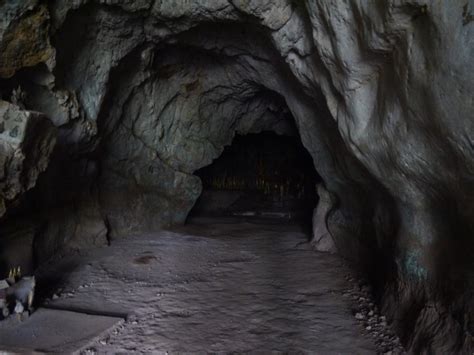
Sits at the mouth of the cave,
Spinning a web,
Waiting,
To catch a wandering grass-seed,
Coaxed on by Autumn’s wind.
Potential Themes (I mind mapped to see what themes I would like to write on) – 25/09/20
– Friendship, nerves, comfort, singing, shyness, acceptance
Quiet Voices – 1st Draft – 25/09/20
Like a creaking floorboard,
hushed by embarrassment.
The beginning of a friendship:
Unsure, hesitant.
You’re showing them yourself,
Hoping they’ll accept it,
Unintentional vibrato, wavering throats,
And when you reminisce,
They tell you they were scared too.
Potential Themes
Nature, rainy summer’s day, Autumn/Winter – idea of hibernation, darkness, odd reasons to be happy or to embrace the cold and rain (no wasps, tea, cosy jumpers) – Winter looming – ominous – 26/09/20
A couple of lines I wrote that I might fit into a poem somewhere:
A crocheted blanket with threads hanging loose.
A novel with rough-edged pages.
A teabag drops into steaming water.


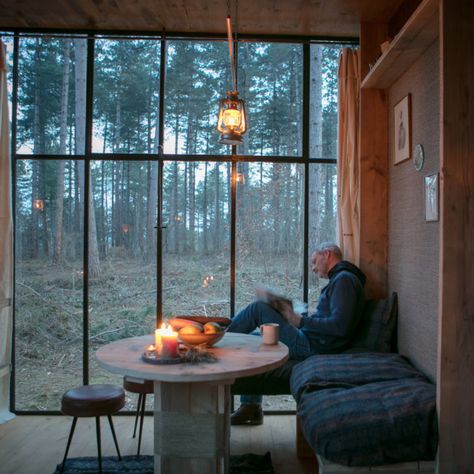
Themes/ideas: Fainting, phobia, anxiety – connect with friendship theme
Unexpected Dinner Guest – Seminar Exercise – 1st Draft – 29/09/20
A roast,
Five girls and one boy at the table.
They all sing Country Roads, Take me Home
While the boy plays guitar.
The girl at the end stands up,
Picks her pink plate from the table,
And shrieks.
The guitar strings buzz,
Another shriek echoes across the table.
Eyes flutter across the floor like shutter lenses,
A thick, black slug,
And another, and another,
black spots covering the floor, the room, the view,
like an old camera burning out,
and then it’s white.
More on rainy summer days or winter approaching…
01/10/20
A collection of lines/images that I could fit into poems:


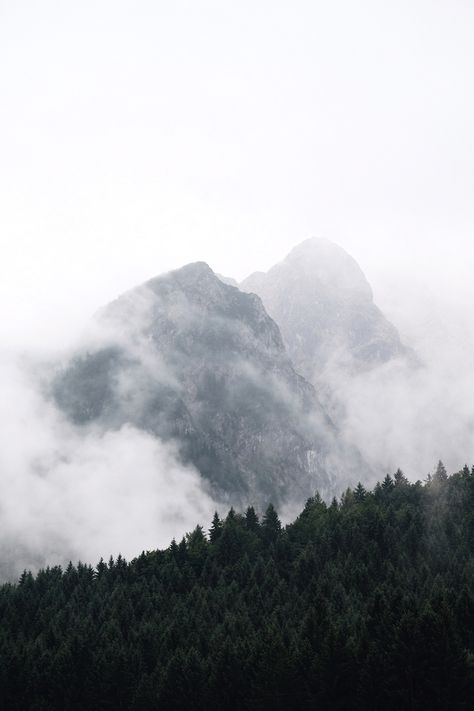
Clouds are thick and dusty,
Looming over cliff edges,
Concealing weathered mountain peaks.
Wasps with barbed-wire stings huddle in their comb.
Zeus holds tightly his bolts,
Metallic tang quivering in the air.
Burnt leaves flake to the ground
at the cool thud of fluid clumps.
Winter’s water washes away Summer’s sticky heat.
That was the day … – Seminar Exercise – 1st Draft – 06/10/20
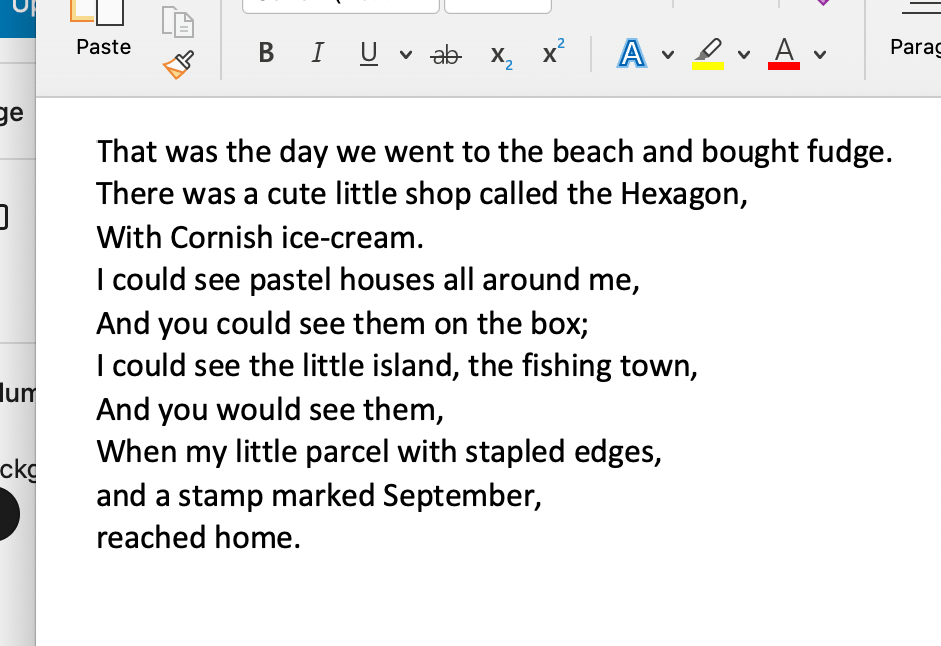
A short draft I did in response to the brief: ‘write a poem beginning with ‘That was the day…’ . I like the mirrored phrases of ‘I could see… You could see … You would see …’ alongside the last three lines. However, I think that overall it is very prosaic, so to improve I would work on the structure, rhythm and sound effects more. It fits well with the themes of friendship, as I drew inspiration from a day put with my friends, and also homesickness as I was discussing the distance between home and university (hence the ‘I could see … you could see’ comparison.
Short poems/ collections of lines to spark poem ideas ( I originally typed these on my typewriter as I find it helps me to be creative):
25/09/20
Quiet voices,
Like a creaking floorboard you try to avoid,
Squeaky and hushed out of embarrassment.
*edit – this developed into the poem ‘Quiet Voices’ (first draft above)*
28/09/20
The ruffled mane, sticking out like you’re trying to be a lion,
Or one of Shakespeare’s kings.
Just a little boy in a superhero costume, make-believing that he’s strong, fast,
Brave, like he’s supposed to be.
Selima Hill’s Cow
I loved Hill’s contrast between the bustling city and sanctity of nature, the search for simplicity, isolation and a fresh start really made this poem stick out for me. I also feel that this is a very non-clichéd poem, as the imagery she uses is almost satirical with the idea of longing to be a cow, which contrastingly intensifies the more serious themes she discusses. “The Tibetans have 85 words for states of consciousness. / This dozy cow I want to be has none… She doesn’t do housework or worry about her appearance… Don’t come looking for me.”
02/10/20
Storm – 1st Draft – 05/10/20 – I plan to change the title of this poem, it is building upon the collection of lines about rainy summer days/ the approach of winter.
Clouds that are thick and dusty,
Roll down the weathered mountain,
And fill the valley below.
A metallic tang quivers in the air,
Zeus is clenching his fists.
The weathered mountain quakes,
The valley cracks and grumbles,
Wasps with barbed-wire stings huddle in their comb,
As a burnt leaf flakes to the ground.
Winter, sits at the mouth of the cave,
Waiting to wash away Summer’s sticky heat.
I think this poem contains some clichéd images that I would need to edit out if I continue with the poem. I also received feedback suggesting that I make it more of a story as it is currently just a collection of different images.
Autumn by Grace Paley
A recurring theme in my poetry has been the transition of summer into Autumn/Winter, and a rainy summer’s day, so I researched some seasonal poems on these topics. Grace Paley’s use of colour in her poem is extremely vivid and creates an effective appreciation of the beautiful Autumnal weather. Her description of reaching also conjures the idea of opportunity and longing, while she has interesting ways of making potentially clichéd phrases non-clichéd. – 06/10/20
“What is sometimes called a
Grace Paley, “Autumn” from Long Walks and Intimate Talks by Grace Paley and Vera B. Williams. Copyright © 1991 by Grace Paley.
tongue of flame
or an arm extended burning
is only the long
red and orange branch of
a green maple
in early September reaching
into the greenest field
out of the green woods…”
Link to full poem: https://www.poetryfoundation.org/poems/48222/autumn-56d22948808b5
Rose – Seminar Exercise (Group sequence poem on Beauty and the Beast) – 1st Draft – 08/10/20
Luscious red velvet,
Soft like a sable-hair brush,
Curl up seductively,
Reaching out,
to be touched.
She stands out from other flowers,
Pale primroses with crisping brown edges,
Dandelions, weeds, withered by the sun,
Unwanted, unwilling.
But there she is,
The brightest red in a monochrome field.
And she’s the one you want,
Because the fibres on her petals look the softest.
But beneath those smooth petals,
Sharp thorns catch your finger.
That’s when you realise why she’s red.
She’s not the crimson of royalty,
The blush of innocent romance,
She is pain, anger,
A redcap goblin,
soaked in the blood of her enemies.
She’s stained by the pain she causes.
And suddenly it’s not beauty anymore,
It’s wickedness.
- I researched different types of brushes as I knew that I wanted to compare the rose-petals to a really soft brush. One of the recurring words in our group mind map for our ‘Beauty and the Beast’ sequence was brush and the idea of painting, so I wanted to build this into my poem. I found that a sable-hair brush is one of the softest and I also think that the word ‘sable’ fits well in the context of the poem, as it has particularly soft-sounding letters, and its closeness to the word ‘stable’ fits with the fairy-tale theme.
- I also researched the red-cap goblin image, as I wanted to find a figure in mythology associated with the colour red. After reading about the red-cap goblin I felt that it would really fit this poem as the rose is meant to be showing that beauty on the outside does not mean beauty within, and thus, the rose being red due to the blood of her victims links with this well.
Rose – 2nd Draft -11/10/20
She stands out from other flowers,
Pale primroses with crisping brown edges,
Dandelions, weeds, withered by the sun,
The brightest red in a monochrome field.
And she’s the one you frame;
Her petals are the softest.
Those luscious red velvet petals,
Soft like a sable-hair brush,
Stretching out seductively…
But when you touch her,
Sharp thorns prick your finger.
Then you realise why she’s red.
She’s not the crimson of royalty,
The blush of innocent romance,
She is pain, anger,
A redcap goblin,
soaked in the blood of her enemies.
She’s stained by the pain she causes.
And suddenly she’s not beauty anymore,
She’s the old hag, black and wrinkled,
Who clings to her beautiful façade,
Because on the inside, she’s riddled with maggots.
- When editing Rose, I tried to give the poem more of a structure and felt that it fit into tercets quite well. I also cut out unnecessary lines and re-phrased things so that they were more impactful.For future edits I need to get rid of abstract nouns like ‘pain’, ‘anger’ and replace them with more tangible images.
Inspiration (16/10/20):

august by Taylor Swift

Salt air and the rust on your door...

I can see us lost in the memory,
August slipped away into a moment in time...

I can see us twisting in bedsheets,
August sipped away like a bottle of wine...

Remember when I pulled up and said "get in the car" ...

Back when we were living for the hope of it all.
I think Swift both creates a really specific and personal experience in the song while also making it relatable to the listener. august also combines the idea of a romantic relationship with images that relate to the atmosphere of summer, which is similar to my plans to connect the two overarching themes of my poetry: friendship and seasons. In particular, the first line of the song ‘Salt air and the rust on your door’ for me is a very powerful image that introduces the atmosphere of the poem in a tangible, non-clichéd way. I also admire Swift’s detailed images and how her voice is maintained throughout the poem.
Dance Jumper
1st Draft – 13/10/20
It’s tatty now, My dance jumper.
I remember walking to dance;
Mid-October, and I was – chilly.
The journey was always chilly.
One day I went to collect my jumper;
I was alone, and I didn’t mind the cold.
But when I put my jumper on it was – cosy.
It’s tatty now, But I won’t replace it,
I’ll buy more jumpers, from work-do’s or group trips;
Someday it’ll be a small square in a large quilt of tatty jumpers.
But it’ll be the centre, it’ll be the biggest,
And when I’m eighty, and snuggled under it,
I’ll still cherish its warmth.
Although I am not keen on the draft, I think that the idea of the ‘Dance Jumper’ poem will work well with my poetry, as I can use the jumper itself as a metaphor for friendship, while it also fits well with the themes of cold weather and seasonal change. I was experimenting with the idea from a seminar in which we looked at the poem Young Pterodactyl, by Matthew Gregory, of writing a poem that is one extended metaphor, so I used the ‘Dance Jumper’ as a metaphor for friendship. – 13/10/20
Your Son is Rich – 1st Draft – 15/10/20
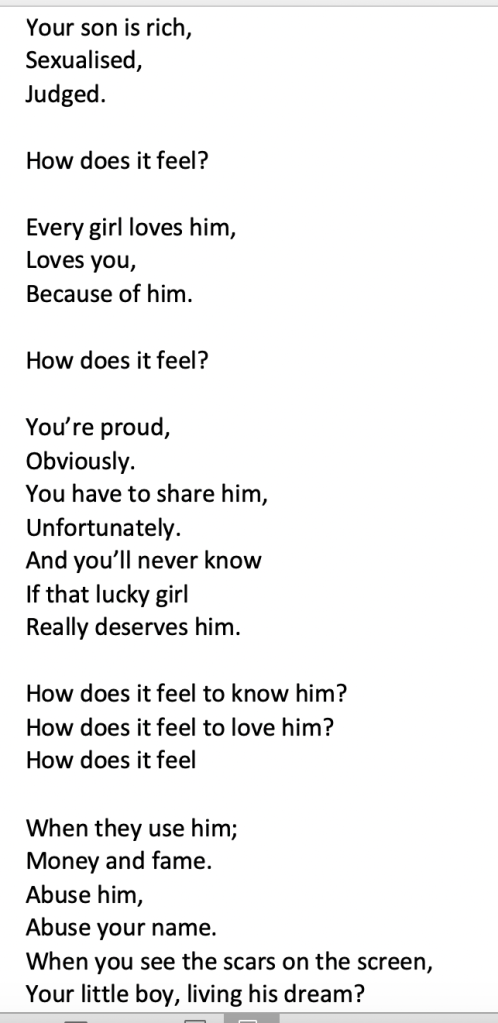
I wrote this poem addressing the mother of a celebrity, as I felt that it was an interesting angle to look at fame from that perspective. The voice is that of an onlooker asking the mother what it is like to have a famous son, incorporating envy, intrigue and pity. To edit this poem I would change the layout of the large middle stanza and maybe make more of a distinct and maybe repetitive structure. I think the final couplet is effective as it leaves the reading questioning whether fame is a positive thing or not.
Dance Jumper – 2nd Draft – 17/10/20
It’s tatty now, my dance jumper.
I remember walking to dance; mid-October.
I was alone, cold.
I thought I didn’t mind.
It’s tatty now, but I won’t replace it.
One day it will be a square, in a quilt of tatty jumpers.
But it’ll be the centre, the biggest.
And when I’m eighty, and snuggled under it,
I’ll still cherish its warmth.
In the second draft of Dance Jumper, I cut down the lines significantly, so I could see more what images and themes are working, and what to carry forward into subsequent drafts. I like the idea of tattiness, and the contrast between being cold and alone and cherishing the warmth. However, I feel that I need to make it much more focussed on the jumper itself and using that (along with weather and coldness) as a metaphor for friendship vs loneliness. I would also like to work on the rhythm of the poem, and experiment with different forms. I think that the images could be much more detailed and descriptive as well. -17/10/20
I want to be sad – 1st Draft – 19/10/20
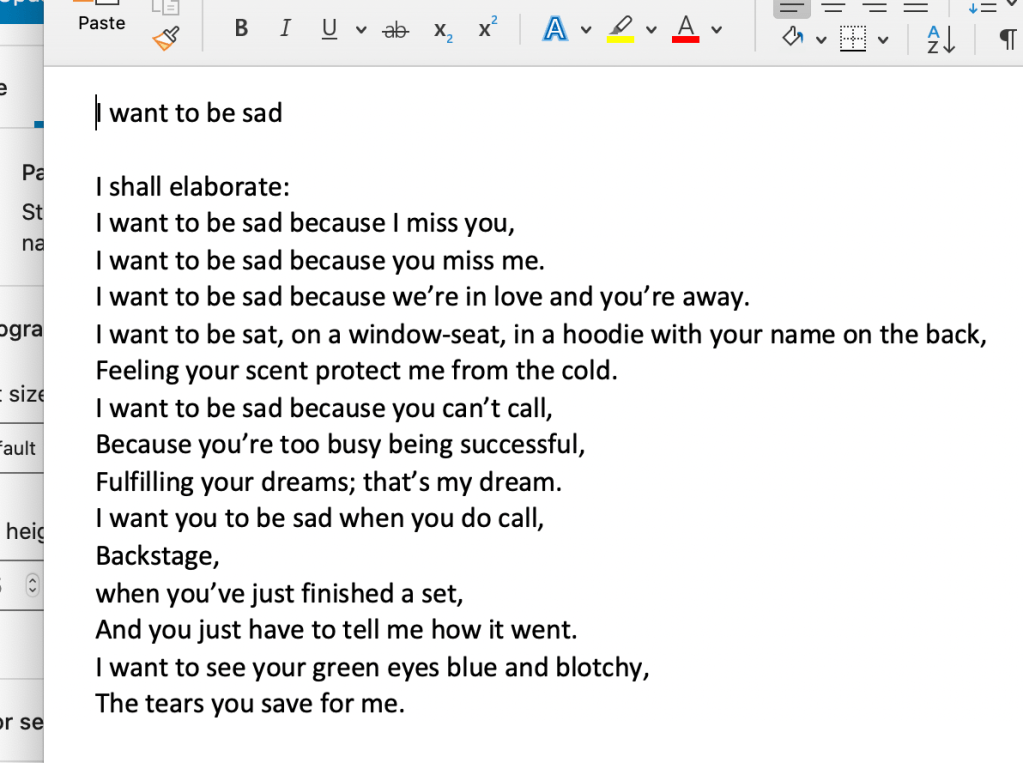
In this draft I experimented with the phrase ‘It’s better to have loved and lost’, playing on the idea of sadness caused by love, and whether that’s better than being happy and not in love. This also fits with the celebrity theme of Your Son is Rich. I think the anaphora of ‘I want to be sad’ is effective, particularly when it breaks as it then changes the pace of the poem in line with the increasing desperation. I think the ending is a little abrupt so if I develop the poem further I would make it longer and have a more significant end.
I Want to Go to the Forest – Seminar Exercise – 1st Draft – 20/11/20
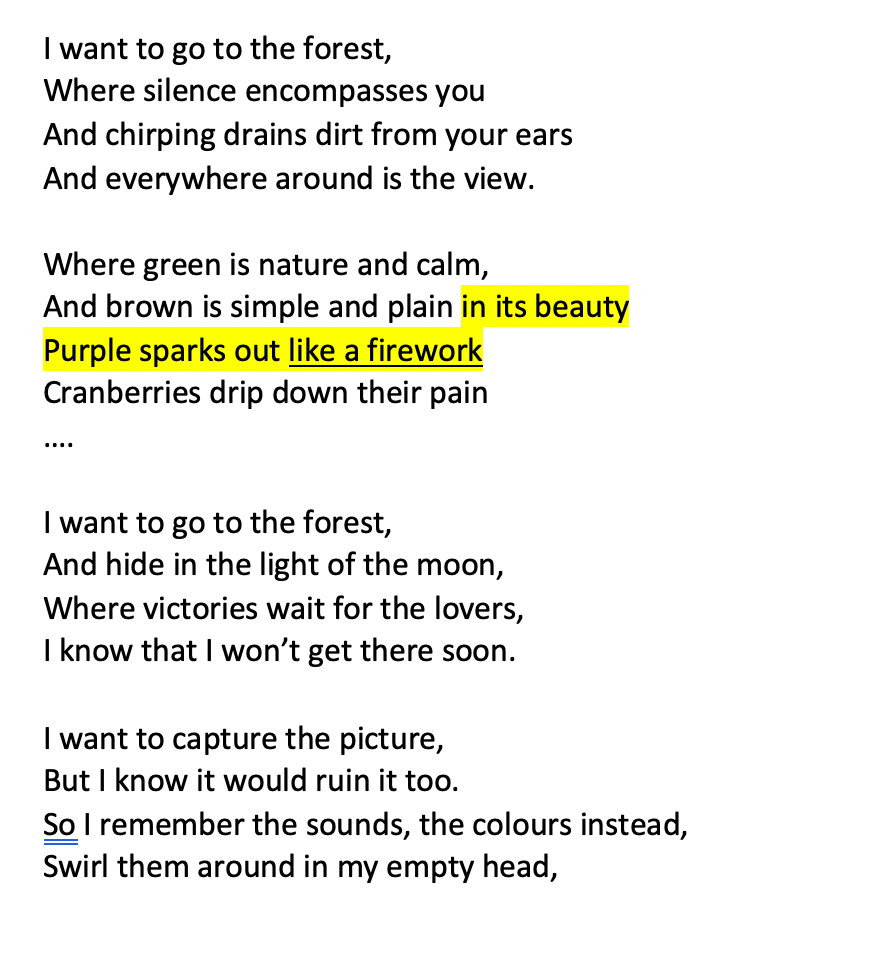
This was a seminar exercise for a seminar on rhythm, in which we had to write about a place we wanted to go. I chose the forest inspired by the view from my window and the forest walks I went on around my house during the lockdown. To improve, I need to use enjambment in order to make my end-rhyme feel less clunky and restrictive. I really like the image of ‘chirping drains dirt from your ears’ as well, however, I think in general there are a lot of clichés in this poem which I would also edit into more unique images.
Do You Remember? – 1st Draft – 21/10/20
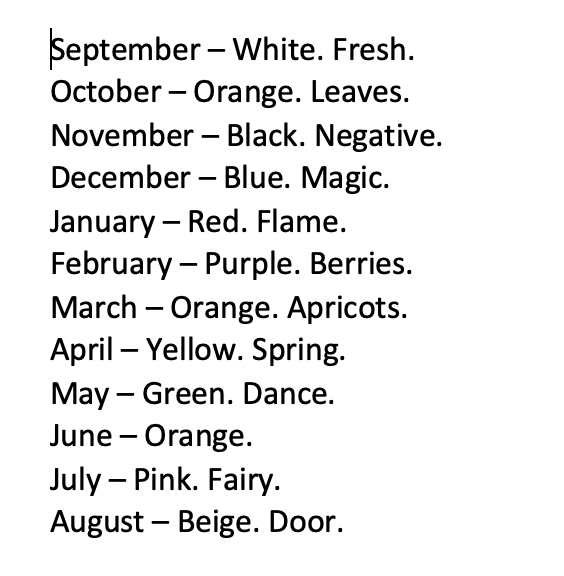
This draft was an experimentation playing on the idea of seasons. Seasons is one of the themes I am thinking of using for my compilation of 10 poems, so I thought I would write a poem going through the months and seeing what colour and word I associated with them. I called it Do You Remember? because the songs ‘September’ (by Earth, Wind and Fire), and ‘august’ (by Taylor Swift) both use this line in their lyrics, which are also the first and last lines of the poem. I also think that it fits with the idea of memory and why my mind connects these things together. I tried not to worry about whether or not it would be a good poem and tried to have fun with it and be honest to what words genuinely sprang to mind.
The feedback I received on this poem was that it worked better sticking to the second word being a noun, as all the rest were so it seemed out of place to have ‘Negative’ for November, and no second word for June. I also received comments on how it worked better with the really odd connections rather than the more obvious ones as it made the reader wonder why I had made that connection, and sparked them to make their own connections based on those words. People also picked up on the fact that ‘orange’ appears for three different months, which again was interesting as it was just a result of the colours I associated with those months for different reasons.
Overall I think that the process of writing this poem and the feedback I received was very interesting and will help me when I write others, despite the fact that I may not develop this one further.
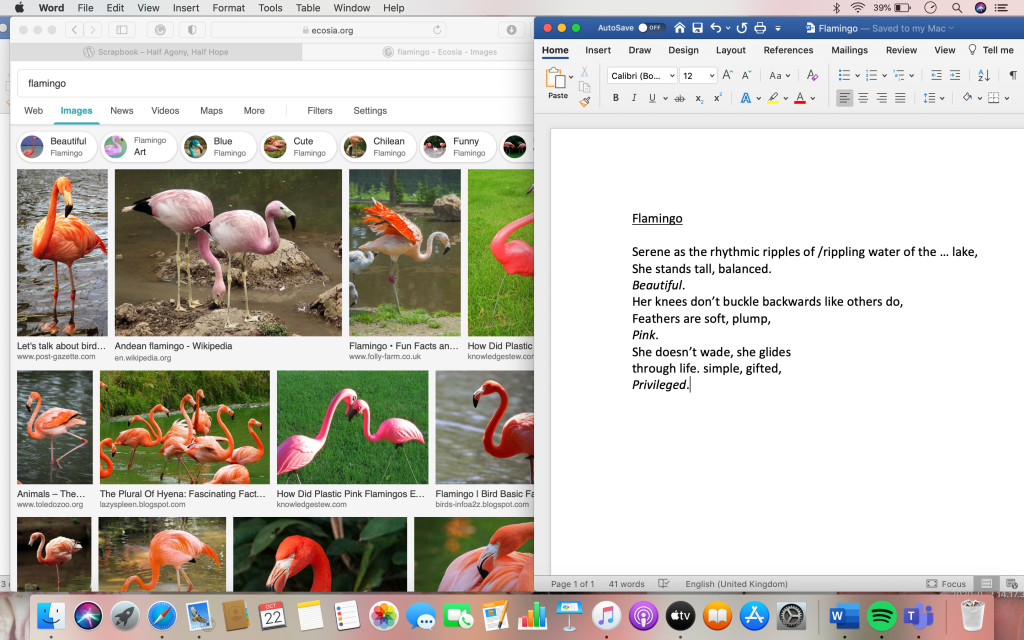
A screenshot of a draft – Flamingo – 22/10/20
I like the form this poem is taking, with the first longer line, then an enjambed tri-colon of adjectives, enacting the feathering of a bird.
I feel that the one-word lines stick out and highlight the key themes, however I think I could improve the sense of story and overall flow of the poem.
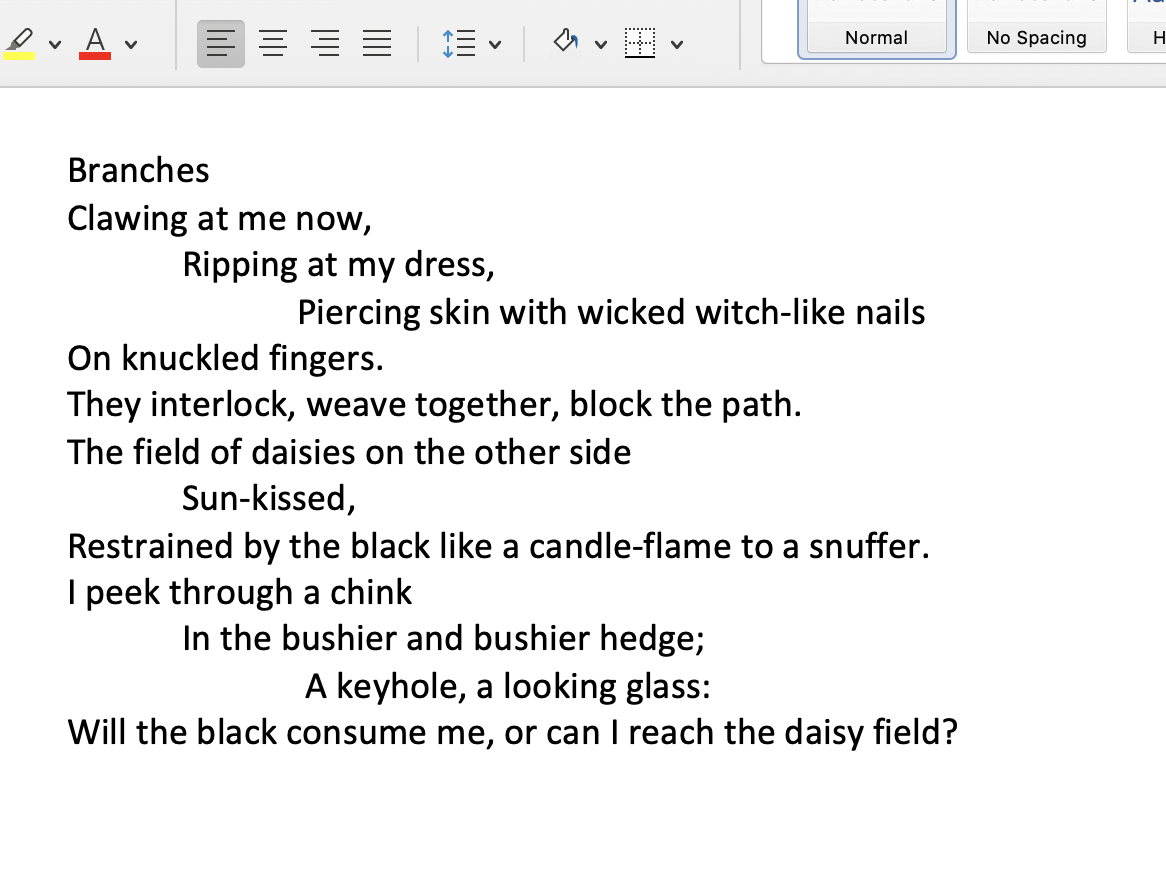
Branches – 1st Draft – 24/10/20
I feel that Branches links well with my previous poem Rose it as it also has a fairytale/into the woods feel to it, with similar themes of magic, good-vs-evil and nature.
I wanted to experiment with form, to try to mirror the idea of branches sticking out, and also to suggest reaching/trying to get through, but then suddenly being cut off, where the lines move out further and further and then snap back to the edge.
To improve this draft I need to work on the rhythm of the poem, add more sound effects, and develop the structure. I also feel that it has a relatively abrupt end, and doesn’t feel finished.
Recurring themes:
Forest, nature, beauty, loneliness, friendship, cold, weather
Forest Walk By Kristine O’Connell George (2001) -25/10/20
My Analysis
George’s poem combines an interesting structure with vivid sound effects in order to create an effective forest atmosphere. I aim to build both of these elements into my own poetry. I also admire how she leaves us with an uncanny sense of loneliness in a dramatic, yet indifferent way, exaggerating the atmosphere of invisibility throughout the poem, especially when you re-read it. The line ‘no branch-crack’ particularly stands out to me, as I think the word ‘crack’ has a really strong sound. The end of George’s poem makes me think of the phrase ‘if a tree falls in the woods does it make a sound?’ Which I think would be an interesting topic to write on.
Forest Walk
I’m practicing my
I-belong-here
no-twig-snap
no-leaf-rustle
no-branch-crack
see-all, know-all
float-like-fog
like-smoke
pine-needle-soft
forest walk.
No one will know I’m coming.
No one will know when I’m gone
Link to Poem: https://www.poetryfoundation.org/poems/54679/forest-walk
(I Want to Go to) The Forest – 2nd draft – 26/10/20
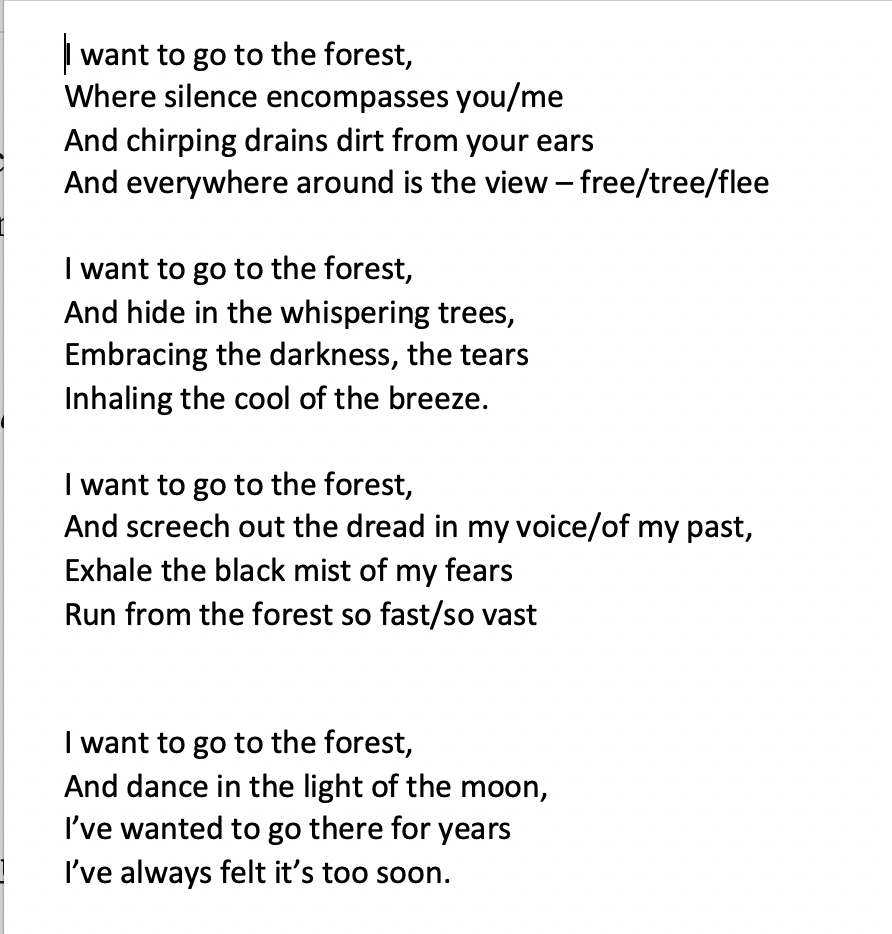
When editing this poem, I cut out the more cliched stanzas and lines and tried to focus on more detailed imagery.
*the slashes indicate where I have two options of what to put there and have not decided on one yet – at the end of the first stanza I have two options for rhyme depending on whether I put you or me on the second line
Looking from the Outside – draft 1 and Looking from the Outside – mid-edit
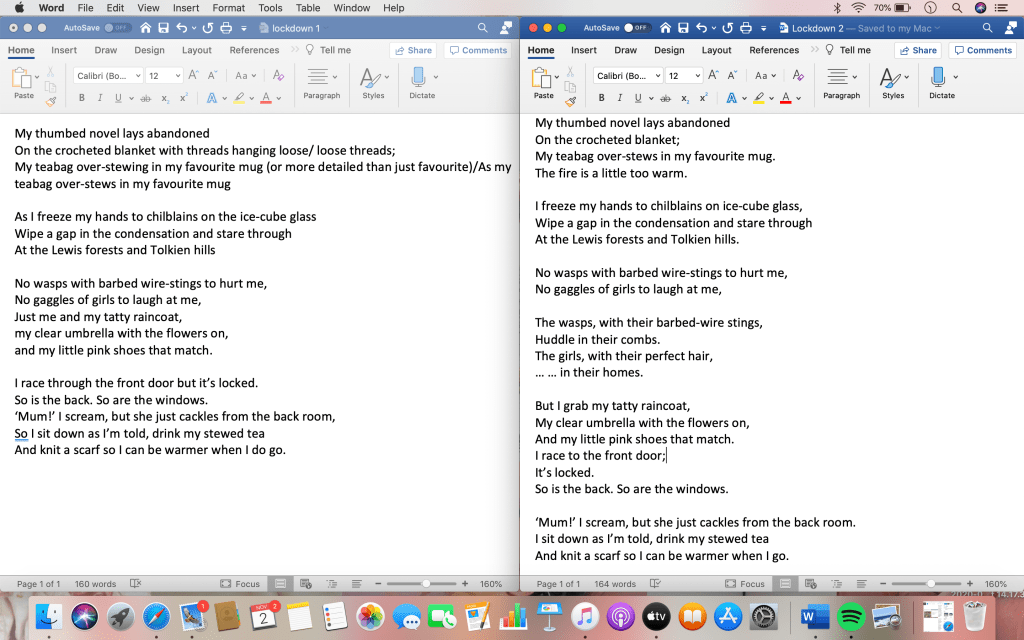
I would like to improve the rhythm of this poem, and intensify the images a bit more (especially the second half), by looking more at sound effects, making it more succinct, and using more detailed, powerful images. I am trying to create the sense of looking through the window, longing to be in one world when you’re stuck in another. I think it links well with Branches in that sense, and also connects with Storm in its setting of winter. – 28/10/20
The French Dance – Seminar Exercise – 1st Draft – 03/11/20
Un, One.
Mother repeated to baby.
Deux, Two.
She crawled, called.
Deux, Two.
Baby echoed.
Trois, Three.
The ease of the switching accent,
Voice gliding between tongues as she flipped
back and forth, devant, derrier,
comme un petit ballerina, with a pretty pink tutu,
I watched, in awe at the parfait pirouettes
And the little baby’s bilingual leaps.
How I envied the child,
Bilingual from birth,
Un, deux, trois, un, deux, trois,
Spinning en pointe,
Fluid, fluent,
Francais et
Englais.
In my seminar we were asked to incorporate a second language into a poem and play with the effects this has. I tried to focus on the sound effects, and am pleased with the contrast between the smooth-flowing French and the sometimes clunky English. I think this, alongside the changes in rhythm, mirror the content of longing to be able to speak as well as the child and mother could. I also like how visually the poem reflects the spinning ballerina. – 03/11/20
Firework Poem – 1st Draft – Seminar Exercise – 03/11/20
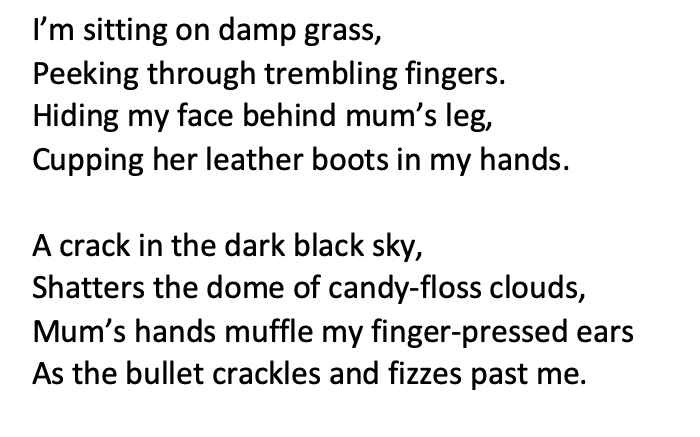
In this seminar we were discussing sound effects. We were given the brief of writing a poem of 2 stanzas, 4 lines each, in which one stanza is quiet and one is loud. I took inspiration from my memory of fireworks night when I was younger and being scared of the fireworks, I tried to incorporate the idea of loss of innocence as a subtle undertone in lines such as ‘shatters the dome of candy-floss clouds’ and the idea of curiosity to find out or to grow up more combined with the difficulty of dealing with what that brings.
Saplings – 1st Draft – 04/11/20
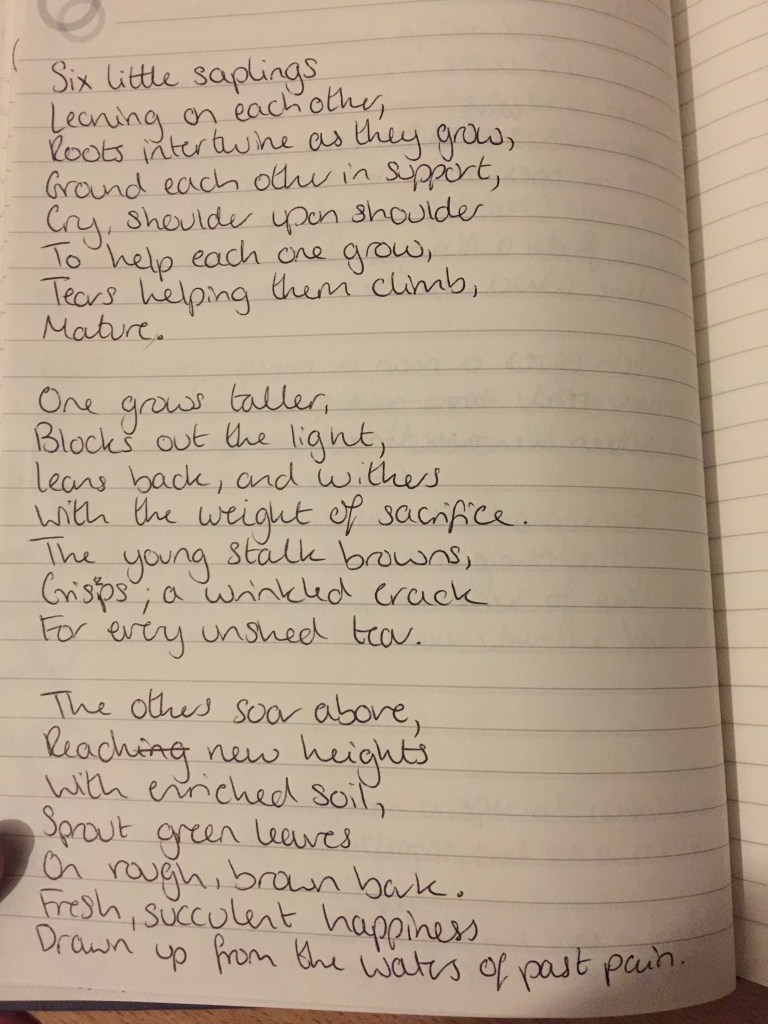
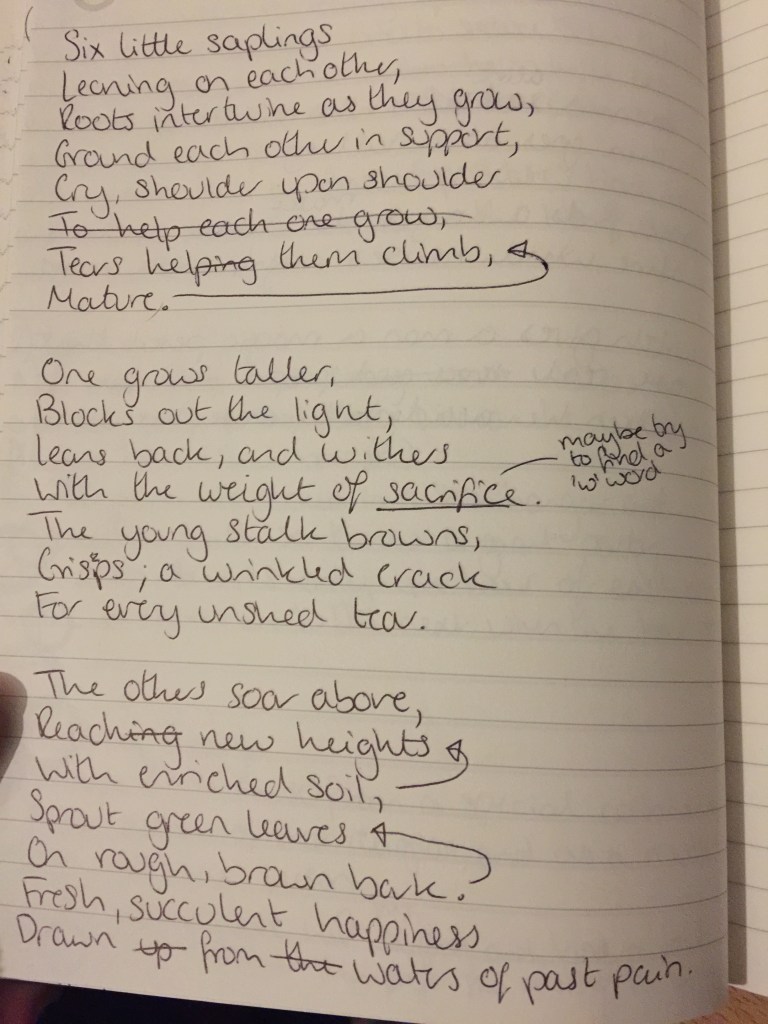
When writing this poem, I was combining the themes of forest and friendship, using my relationship with my housemates as inspiration. I am pleased with how this poem has turned out, however I need to improve the rhythm and intensify the images and sounds, whilst also developing the storyline.
Invitation to the Country – George Meredith – 05/11/20
I need to work on the use of rhythm and rhyme in my poems, so I did some research to find poetry that stuck out to me on account of these aspects. Meredith’s poem uses end-rhyme to add a sense of gaiety to his poem, and the rhythm stands out when you read it, giving the text a light-hearted, jovial atmosphere. I also really like Meredith’s use of sound effects like ‘wet winter bristles’, and how he uses this alongside other techniques to paint a positive image of the countryside that should be left alone to flourish.
‘Come in the season of opening buds;
Come and molest not the otter that whistles
Unlit by the moon, ‘mid the wet winter bristles
Of willow, half-drowned in the flattening floods.’
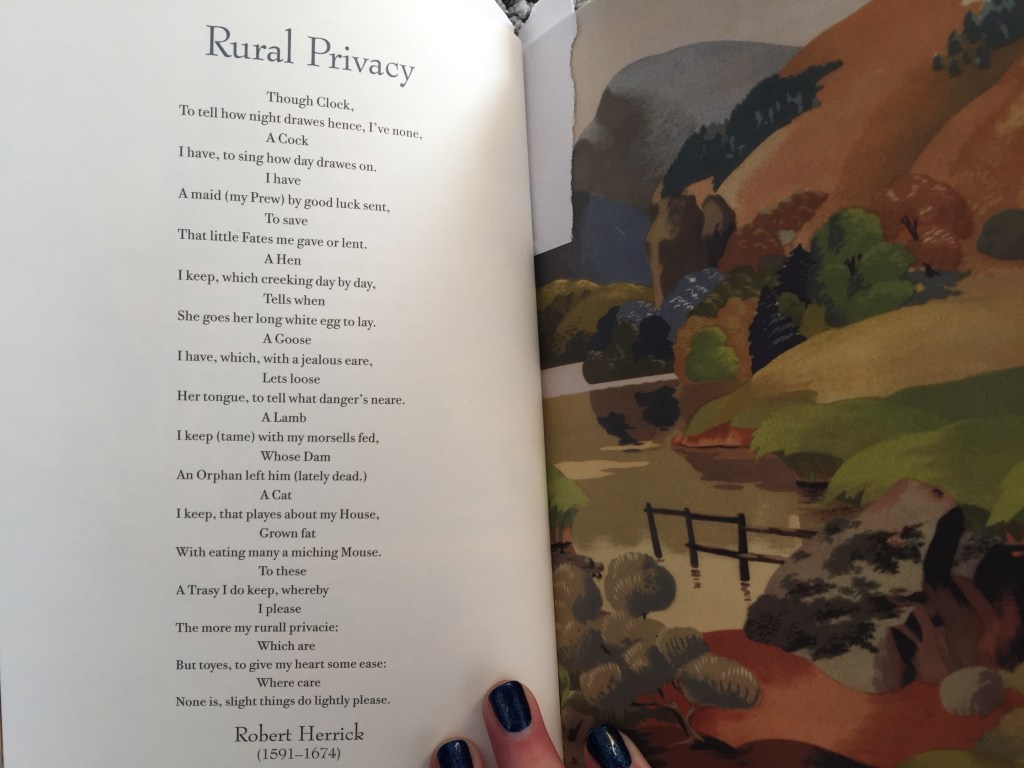
Rural Privacy – Robert Herrick – 05/11/20
Herrick’s poem combines an interesting structure and rhyme-scheme. What made his poem stand out to me is how you can read just the two-word lines and understand the essence of the poem as a whole. Herrick’s use of rhythm is also effective, mirroring the ticking of the clock in the first line, which creates a sense of regularity and time in the poem.
A Forest of Red and Blue – 1st draft – 06/11/20
The forest is red,
Not golden or autumnal.
The branches circle, intertwine,
So fragile, so necessary to life; so terrifying.
When I think about the forest I go deeper and deeper,
Stuck in the thickets when I try to get out,
The Royal Blue and the oxygenated red
Red! Red!
Flashing in my mind
The crimson trees tower around me,
A scarlet canopy forms overhead,
I crouch down. Trapped in a fairy ring,
Spinning in the blurred blood room,
Yellow now, spotting up in the
Red lorry yellow lorry red lolly
Black.
Some feedback I received on this poem:
- Love the final ‘Black’, really good. Line before is great also – the switch to the ‘lolly’ emphasises the confusion and works really well.
- End is really effective
- Struggle to understand the forest’s symbolism
- Maybe a full stop could work on the second line of the second stanza, instead of a comma
- Make the metaphor clearer
- Different title that sets the metaphor up more clearly?
- Use a verb instead of ‘is’ in 1st line – make the verbs of your poems DO more.
- ‘So necessary to life’ is a bit clunky – doesn’t fit with the rhythm
- Don’t have the semicolon before ‘so terrifying’ maybe have it on a new line
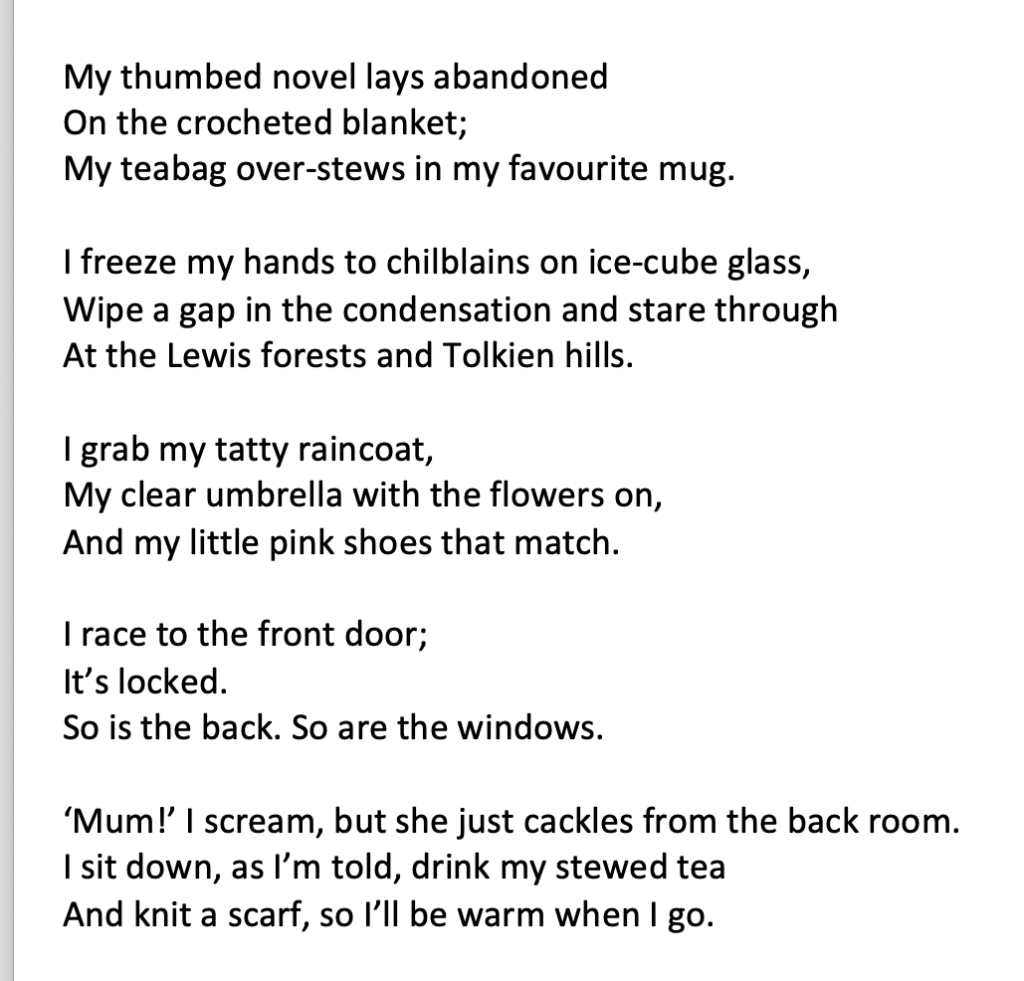
Looking from the Outside – 2nd Draft – 09/11/20
I have improved this poem by cutting out the less effective lines, and making other lines more succinct. I like the tercets, however I still think I need to work on the rhythm and sound effects more, and the ending feels abrupt and clunky. I also do not feel that this title fits with the poem so I plan to change that as well.
Time for Christmas – 1st Draft – Seminar Exercise – 10/11/20
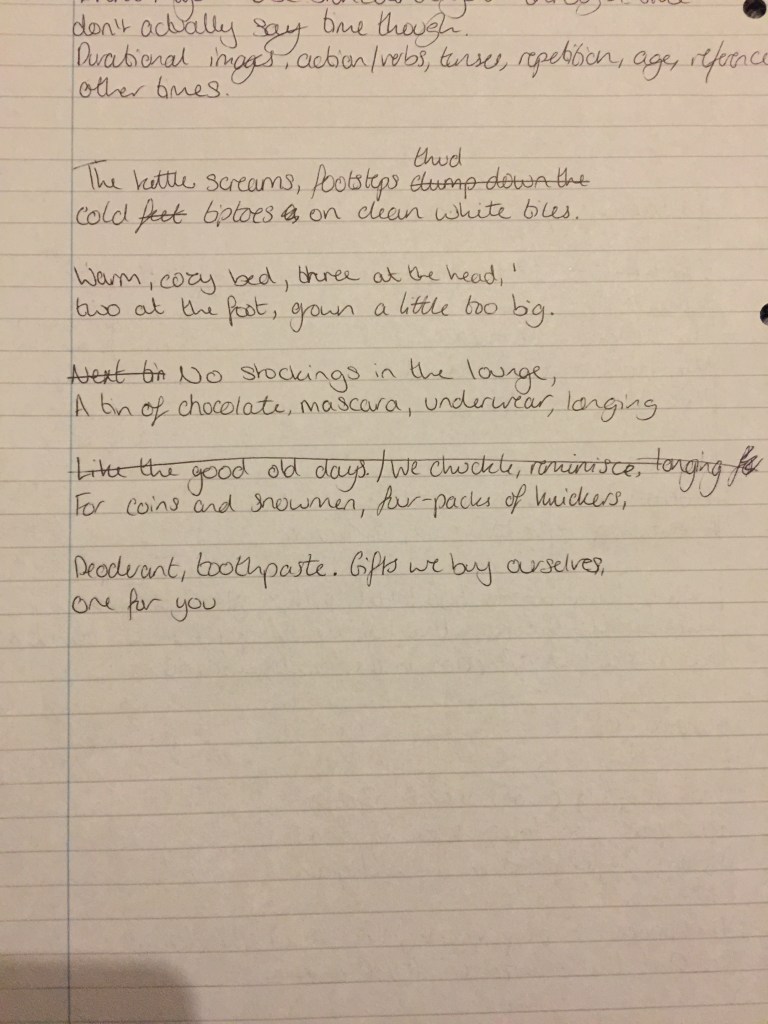
I wrote this poem in week 8, in which our theme was Time, and so we focussed on the use of durational images, tenses, actions/verbs. I decided to write it on how Christmas changes as you grow up and the nostalgia that comes with this. I didn’t finish the poem, but I called it Time for Christmas as, if I continue with the poem, I will discuss how what you want also changes and Christmas becomes a time of wanting to spend time with your family and longing for that childhood again.
Notations of Ten Lockdown Minutes – 1st draft – Seminar Exercise – 10/11/20
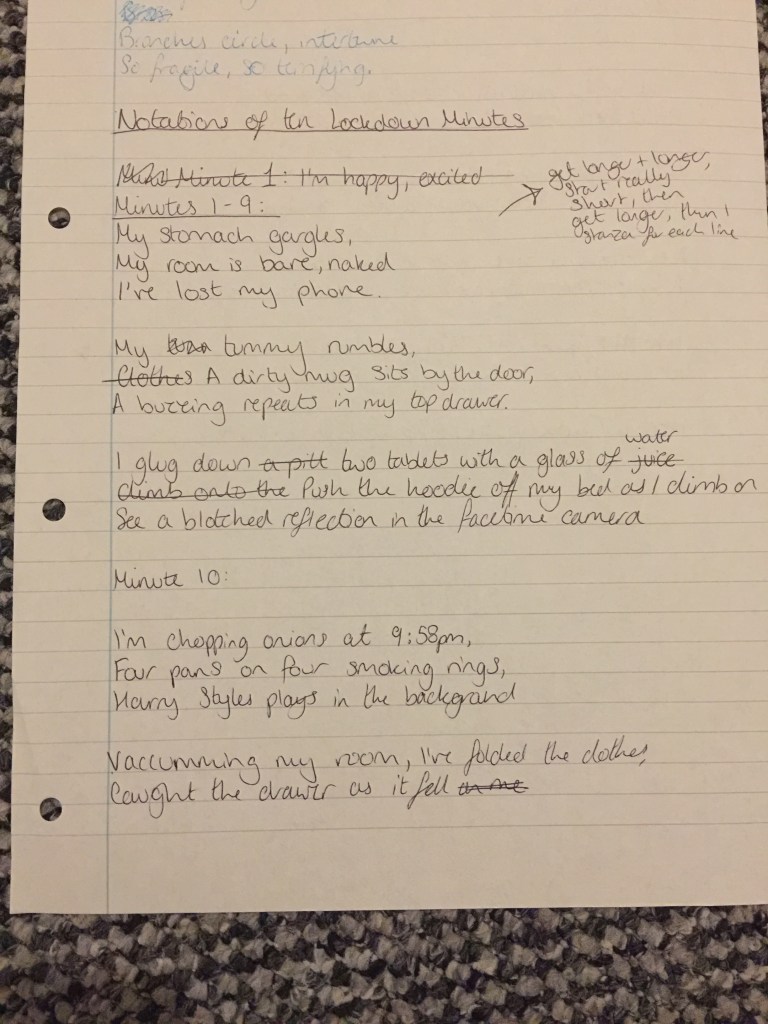
In the same seminar we were also asked to write a poem about a ten minute period, I did mine about how when you are feeling homesick/down, time seems to go so slowly until you final decide to move on and distract yourself and time goes really quickly again. I tried to present the different stages of time in the first three stanzas by focussing on the same locations in the same liens of each stanza (e.g. stomach, room, phone) but I don’t think it had the effect I was going for. However, I do think this repetition of the three focal points is effective in drawing out the original 9 minutes to contrast with the final minute when the narrator suddenly snaps into performance gets loads of tasks done.
Inspiration – 11/11/20
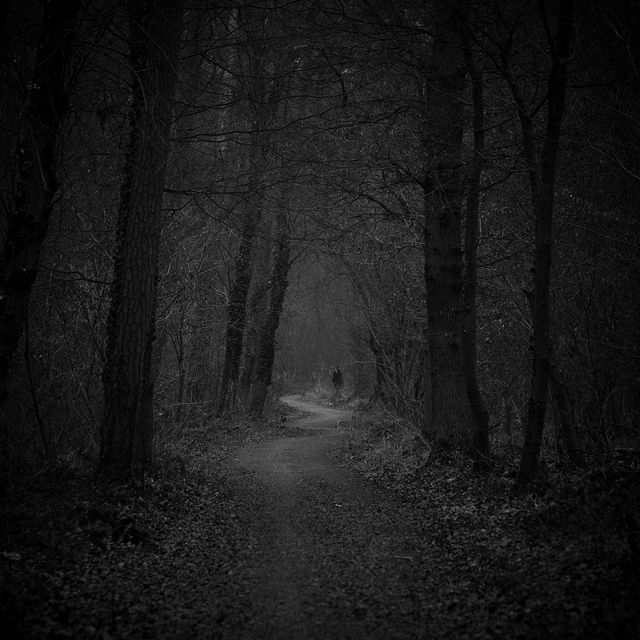
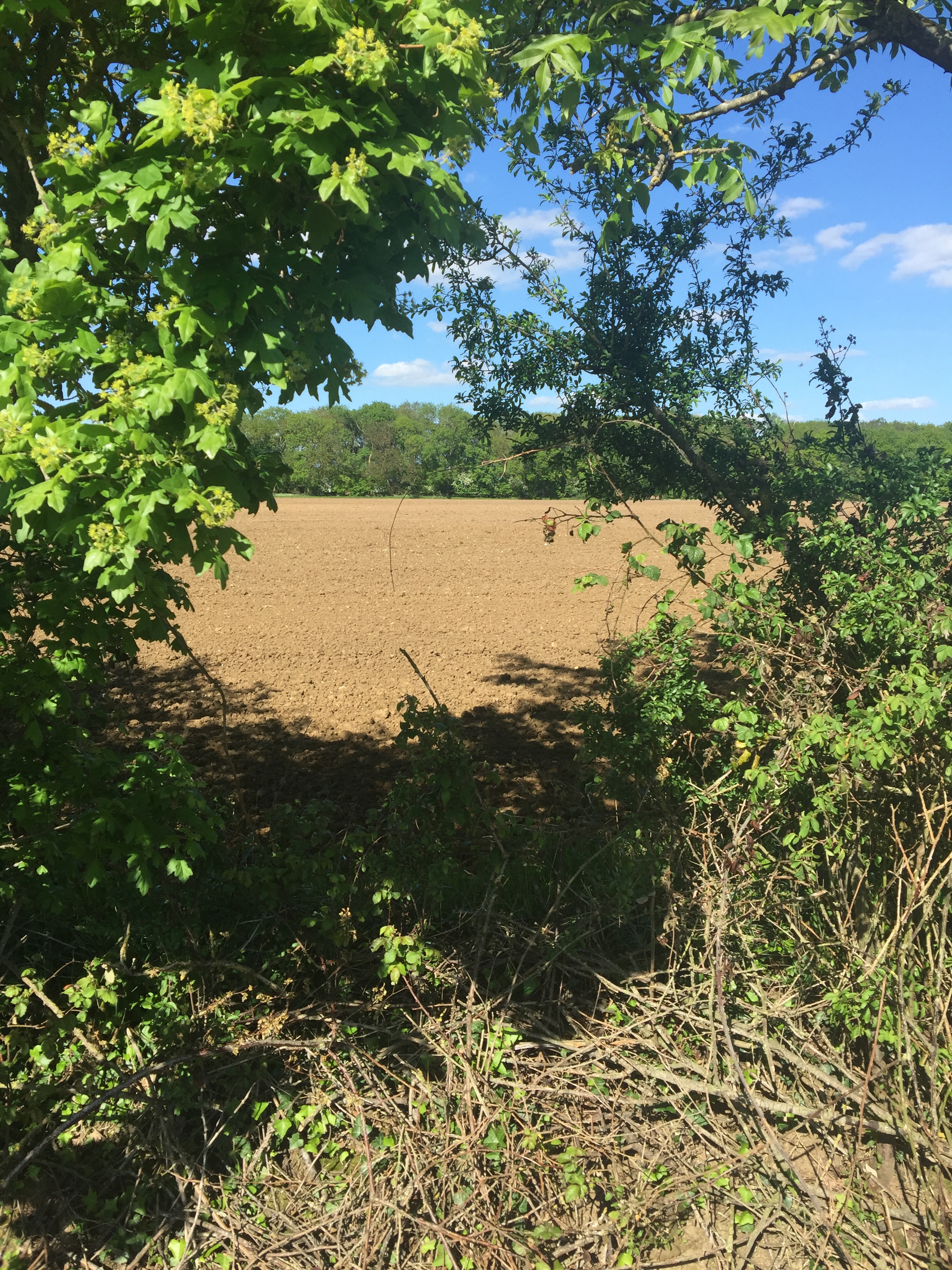
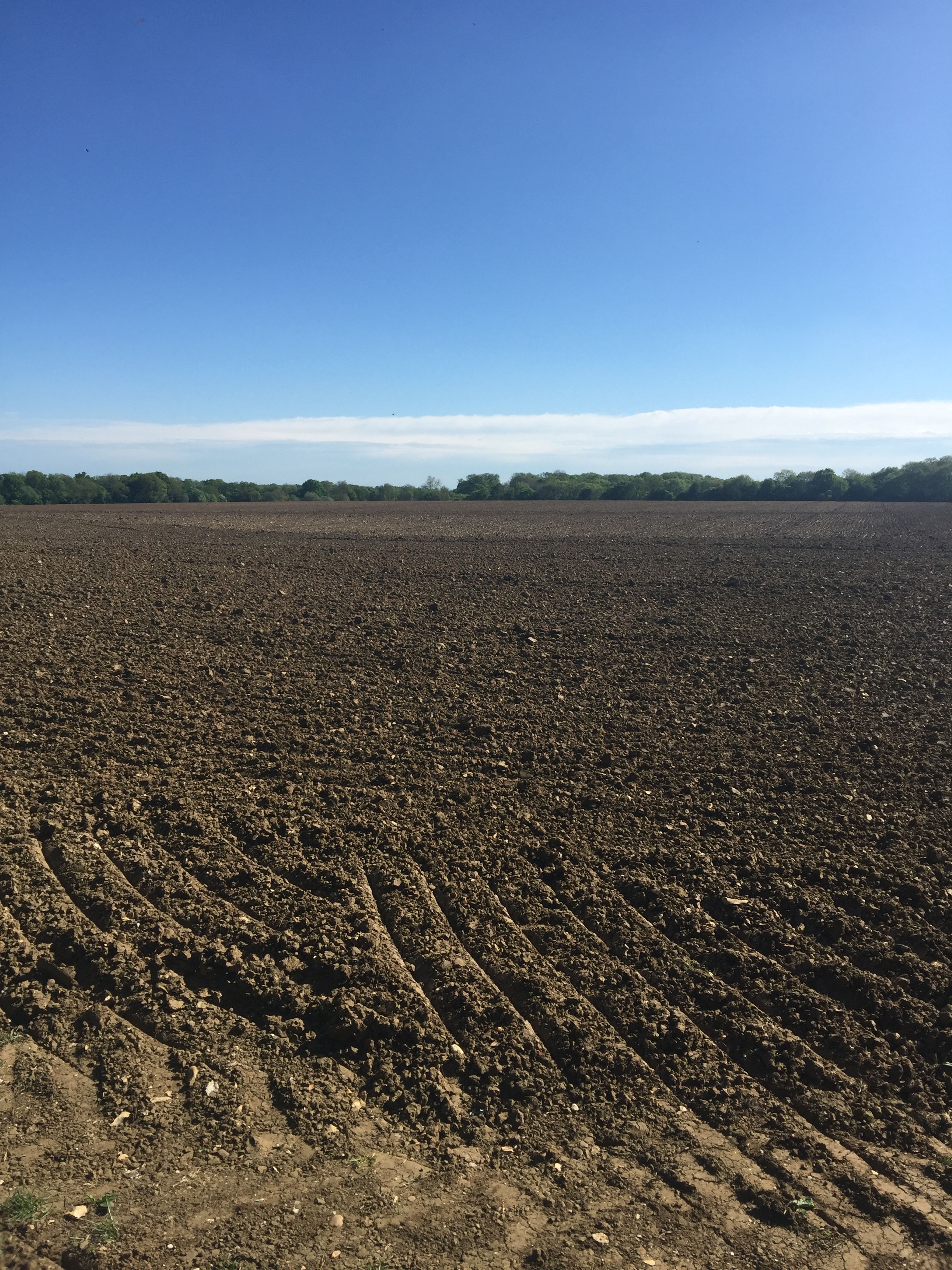
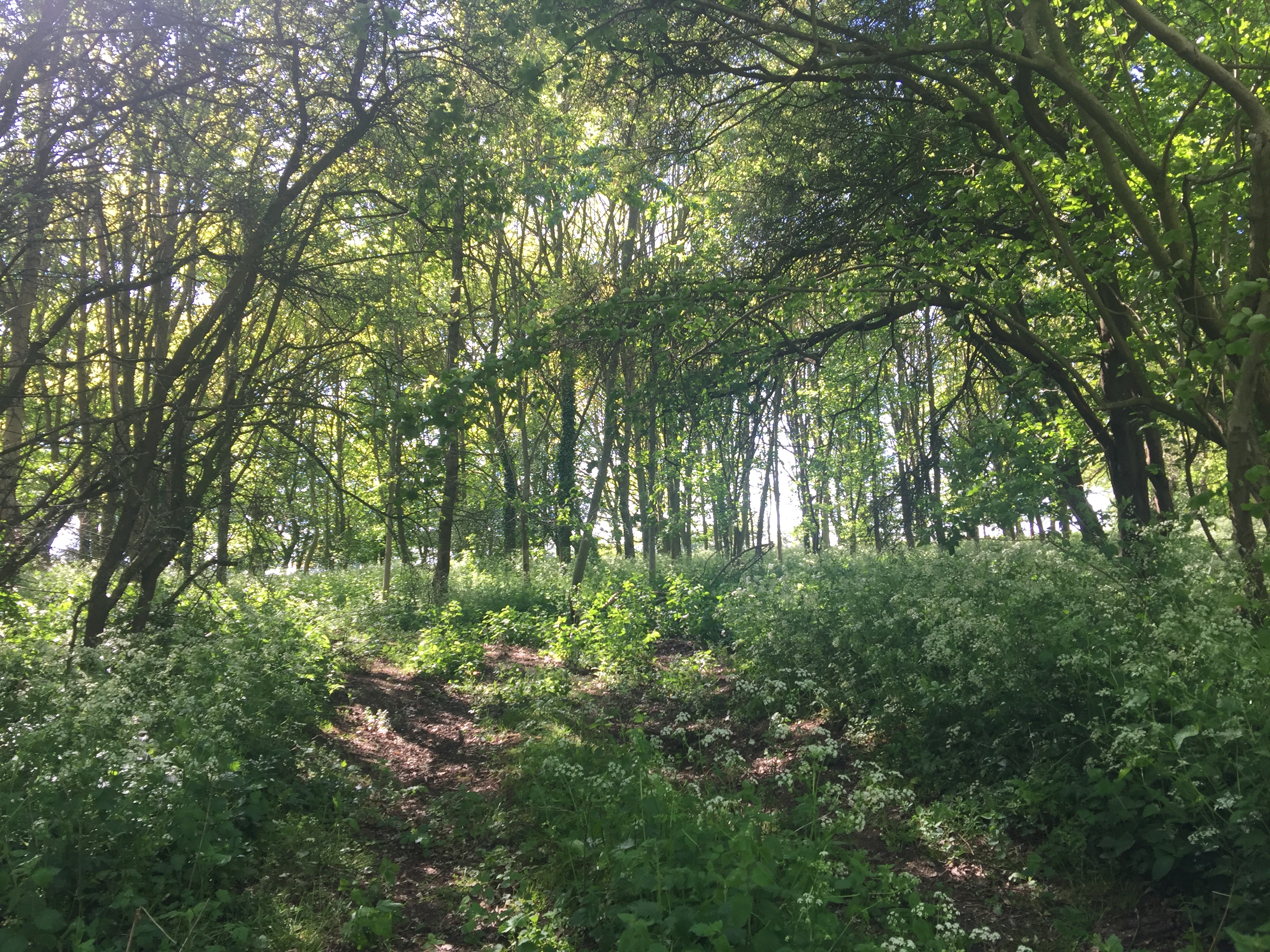
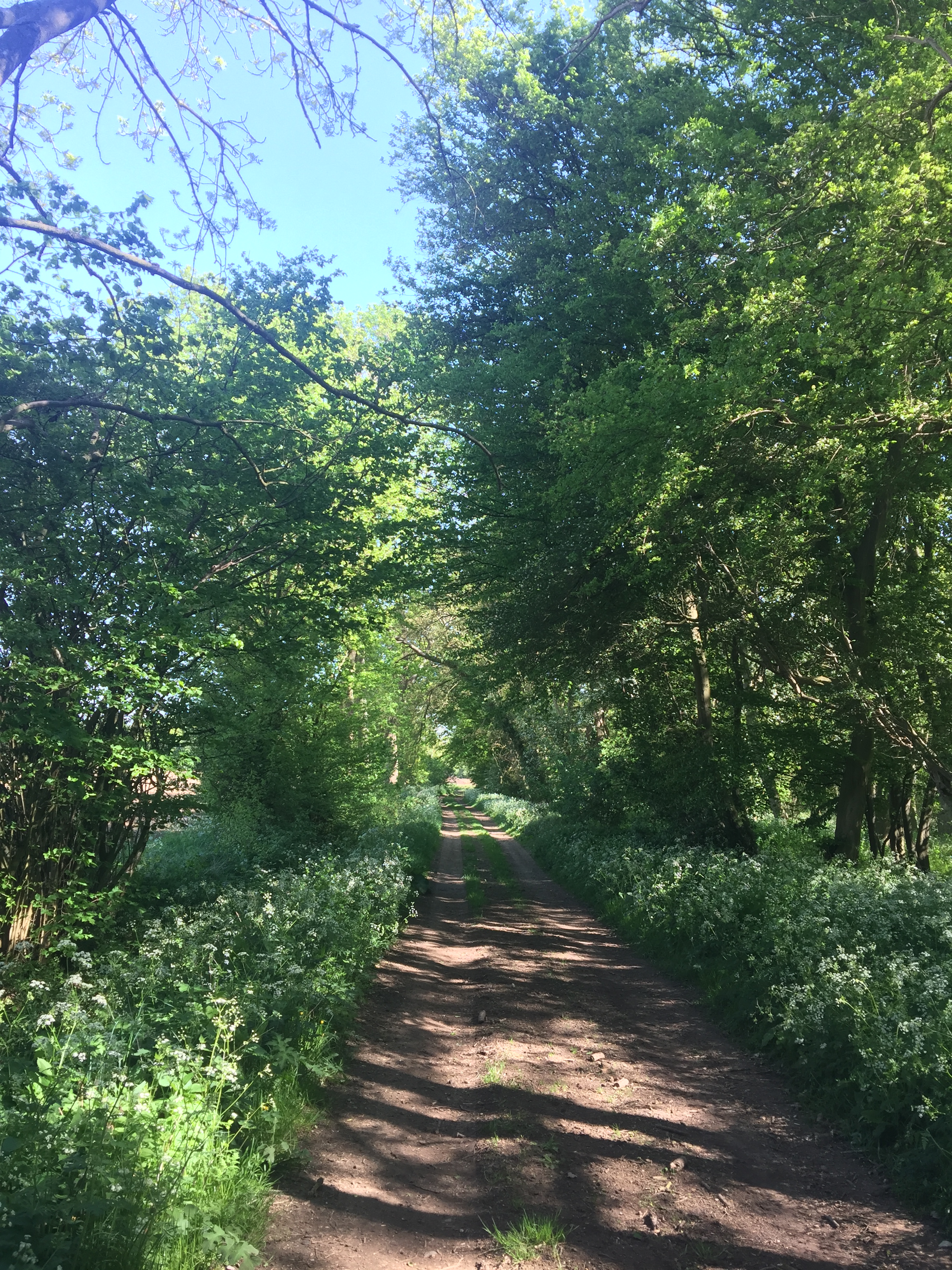
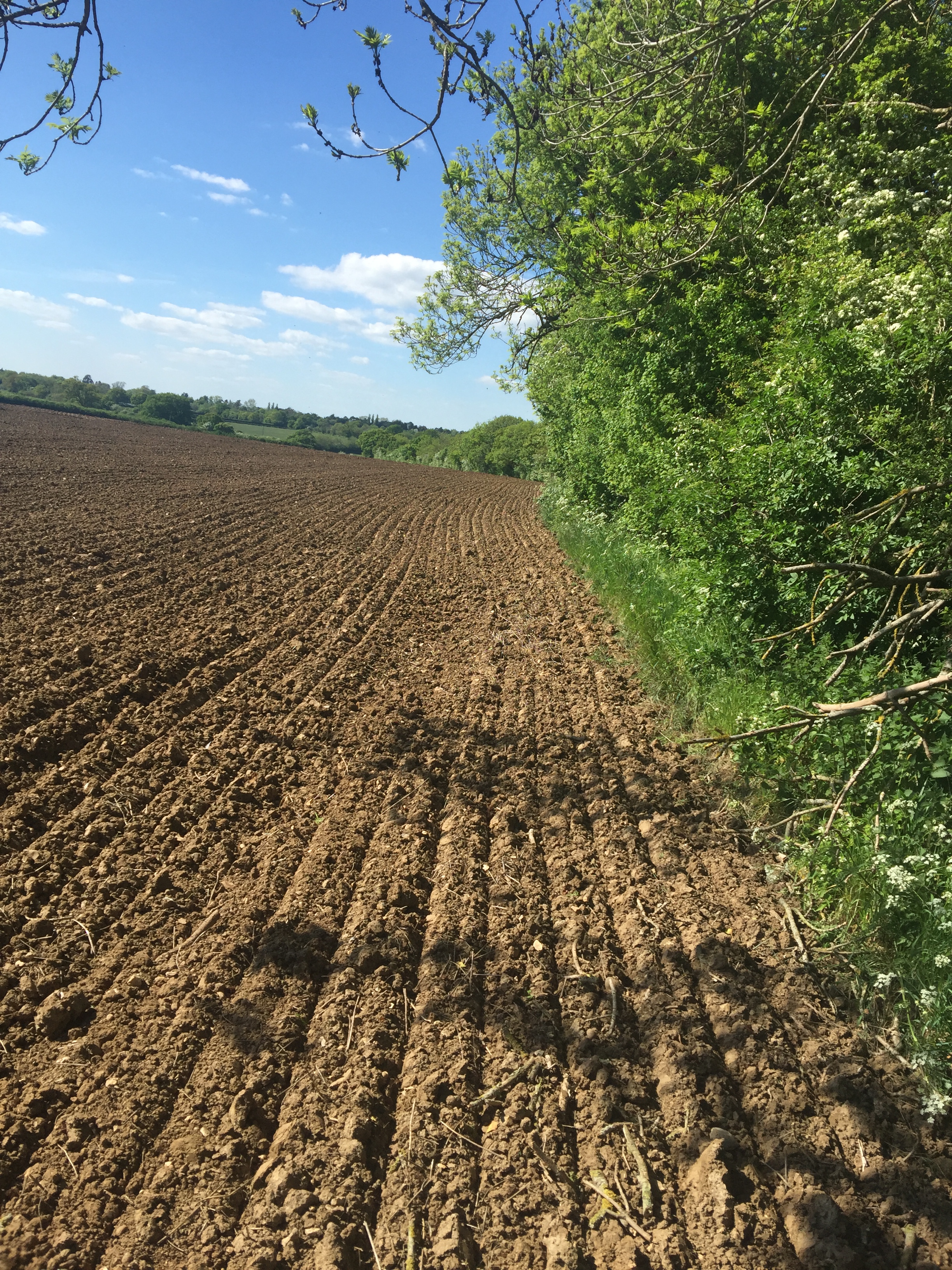
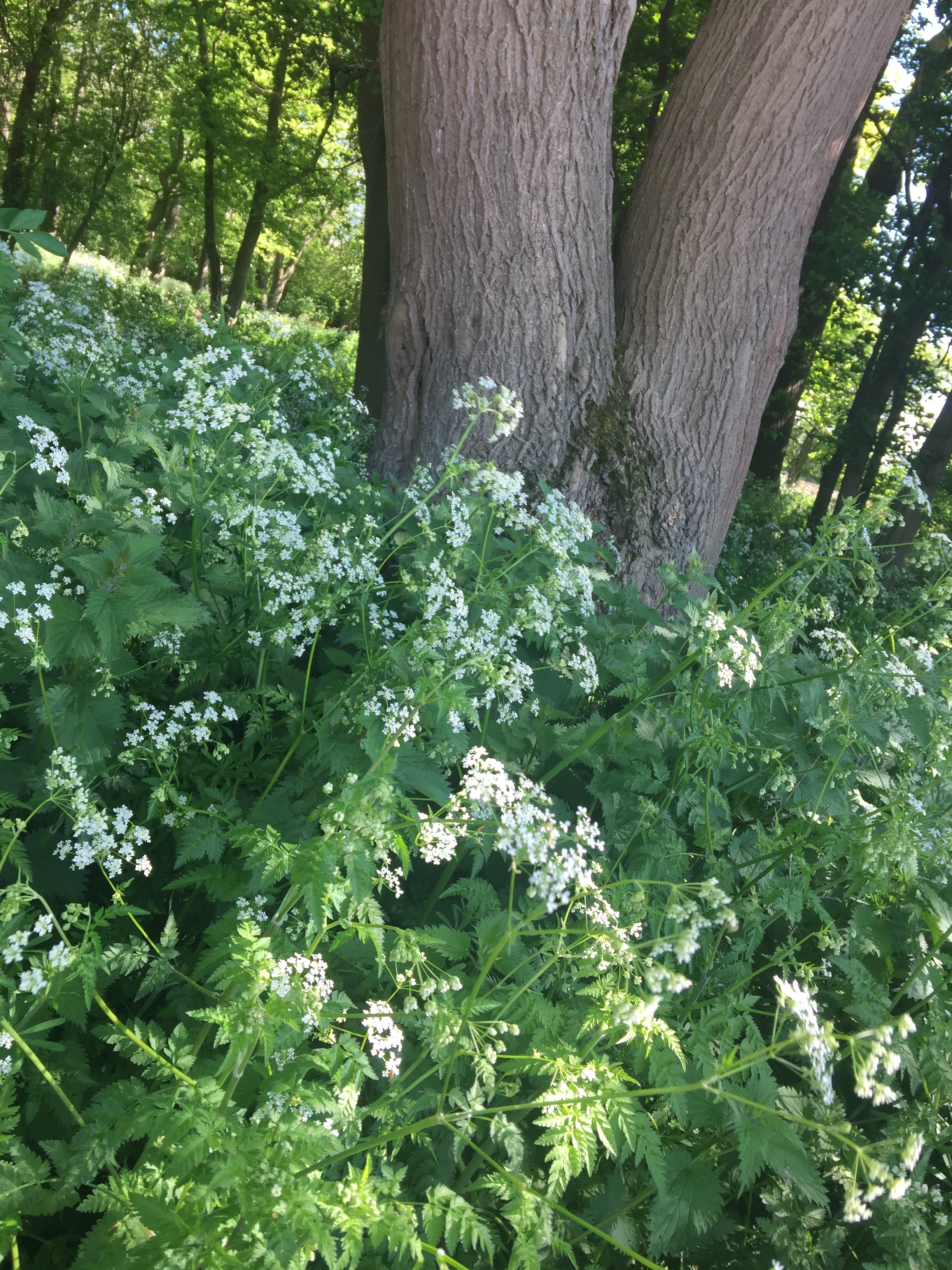
Here are some pictures I took from some walks in the forest that have inspired a lot of my poetry. Particular elements of these images that I have connected with in my poetry are the contrast between the neat fields and the chaotic/messy weeds, alongside the creepy, entangled branches.

Forest Compilation
Here is a link to my first ideas for my portfolio of ten poems. I have decided to focus on the overall theme of ‘forest’. – 11/11/20
Looking from the Outside/Locked/ – 3rd Draft – 12/11/20
I have changed the title of this poem across drafts, but this is the 3rd draft of what was originally Looking from the Outside. I am very pleased with how this draft has turned out, although I still have adjustments to make, particularly the ‘Mum and Dad’ stanza, and the line ‘the glow of the wood-burning stove’ (a little cliched and doesn’t fit well rhythmically). I like how I have started the poem talking about a novel and ended with allusions to some of my favourite authors to suggest the longing for adventure.
My well-thumbed novel lays open,
Abandoned on the crocheted blanket.
The mug of tea that warmed my hands is stewed.
I freeze them to chilblains on ice-cube glass instead.
Wipe a gap on the frosty pane,
And stare, longing, for outside.
Mum’s in the kitchen; parsnip soup.
Dad’s in the office, guitar-music loop.
Outside is clean white snow; crisp, crunching leaves;
Bright lemon daisies; emerald green.
Tatty raincoat, matching shoes,
Clear umbrella with the flowers on.
I run,
Past the trap of warm comfort:
The waft of pease pudding from the oven,
The glow of the wood-burning stove,
The warm milk mug passed across my chest,
The soft-yak jumper pulled over my head,
The tinkling Mozart keys drawing back my ears.
No! I have to go. I have to live.
I want to.
I pull my scarf tighter and tighter,
Stuck on the hook of the door,
Zip up my new white coat – the ropes,
Block out the siren-sounds with its fluffy hood – the wax,
Jump on my boat-shoes and row like Zephyr.
I want the Lewis forests and Tolkien hills,
I want to go to Troy, if it takes me twenty years to get home.
Saplings – 2nd Draft – 12/11/20
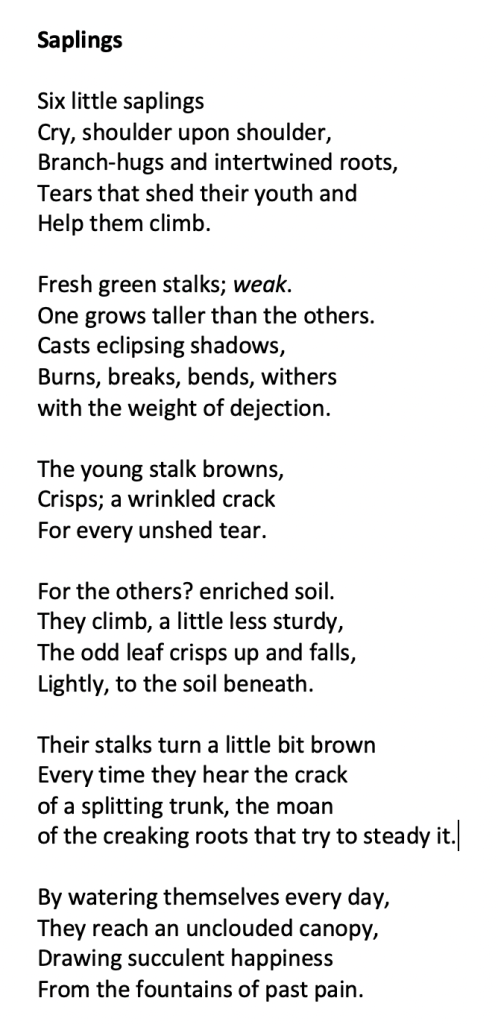
My key focus when editing Saplings was the emotion of the poem, and displaying this through imagery and sound effects. In the first draft I felt that there was a lot of emotion behind it, but it didn’t come through as well on the page. Whereas I feel that I have used more emotive language and stronger images to help portray this. Further improvements would include working on the final stanza so it is more impactful, and assimilating the third stanza into the the second as they have very similar ideas.
17/11/20 – I received feedback on this poem in a seminar, suggesting that the final two lines are too abstract, and that it would be better to leave the reader at the end point of the canopy, as it creates a journey from the roots up to the sky, which I agree with. People said similar things about ‘dejection’ in the second stanza, so I will work on these elements.
Family Tree – 14/11/20
Here is a picture of the first draft of my poem Family Tree. In order to try and add a better sense of rhythm to my poetry I tried writing in iambic pentameter, underlining the words that fell under the emphasis of the meter. As it is difficult to read I have also typed it out beneath. I used the first line of Robert Frost’s Branches for inspiration (‘When I see birches bend to left and right’).
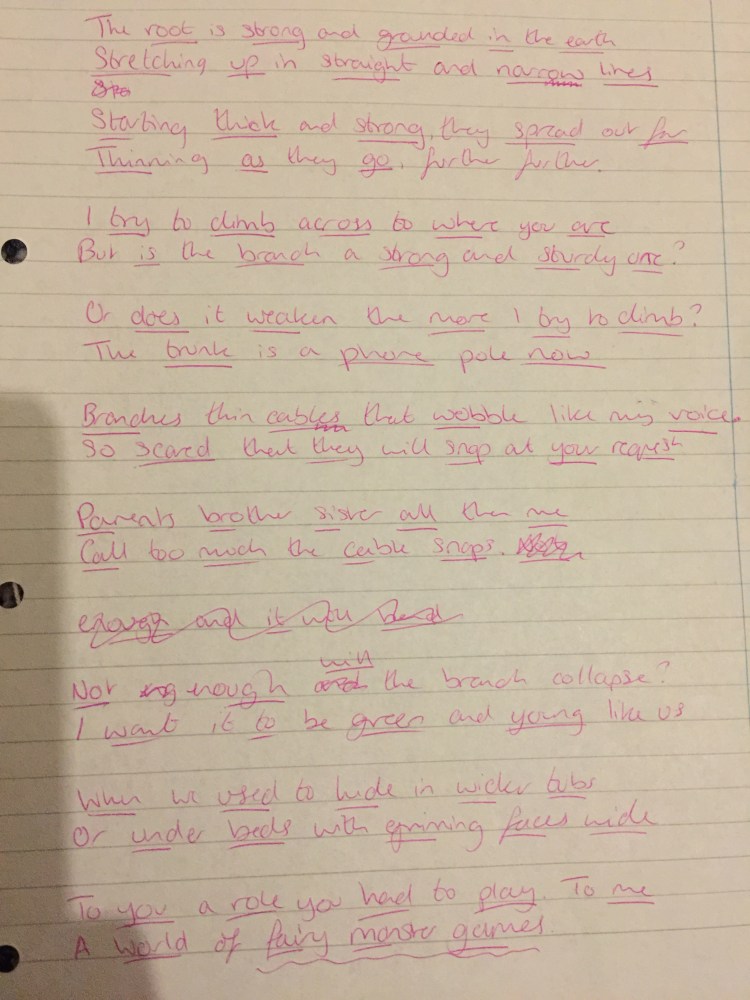
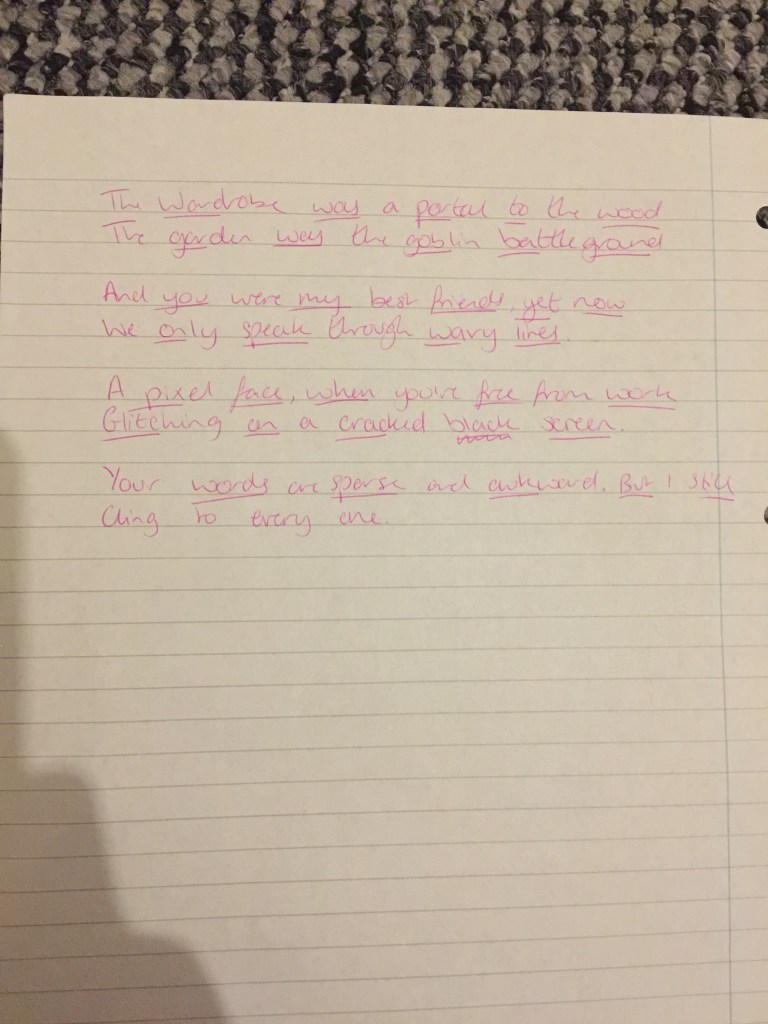
Family Tree
The root is strong and grounded in the earth,
Stretching up in straight and narrow lines.
Starting thick and strong, they spread out far
Thinning as they go, further, further.
I try to climb across to where you are
But is the branch a strong and sturdy one?
Or will it weaken as I try to climb?
The trunk is a phone pole now,
Branches thin cables that wobble like my voice.
So scared that they will snap at your request.
Parents, brother, sister, all, then me.
Call too much and the cable snaps,
Not enough, will the branch collapse?
I want it to be green and young like us,
When we used to hide in wicker tubs
Or under beds with grinning faces wide.
To you, a role you had to play. To me,
A world of fairy monster games.
The wardrobe was a portal to the wood,
The garden was the goblin battleground,
And you were my best friends. Yet now
We only speak through wavy lines.
A pixel face, when we’re both free from work
Glitching on a cracked black screen.
Your words are sparse and awkward. But I still
Cling to every one.
17/11/20 – Post-Seminar Reflection
In my seminar today we discussed poetic voice, one of our exercises was to ask ourselves what our voice is in our poems, what is the attitude?
Looking at the beginnings of my portfolio, I would say that the overarching “attitude” is one of longing. Other aspects of voice that I think my poetry displays are: vulnerability, nostalgia, anxiety, waiting, and solitude (in good and bad lights).
Overall I would say the voice of my poetry is slow, sometimes weak/passive. However, there is often a burst of excitement or fear that changes the pace.
Novel – Seminar Exercise – 1st Draft – 17/11/20
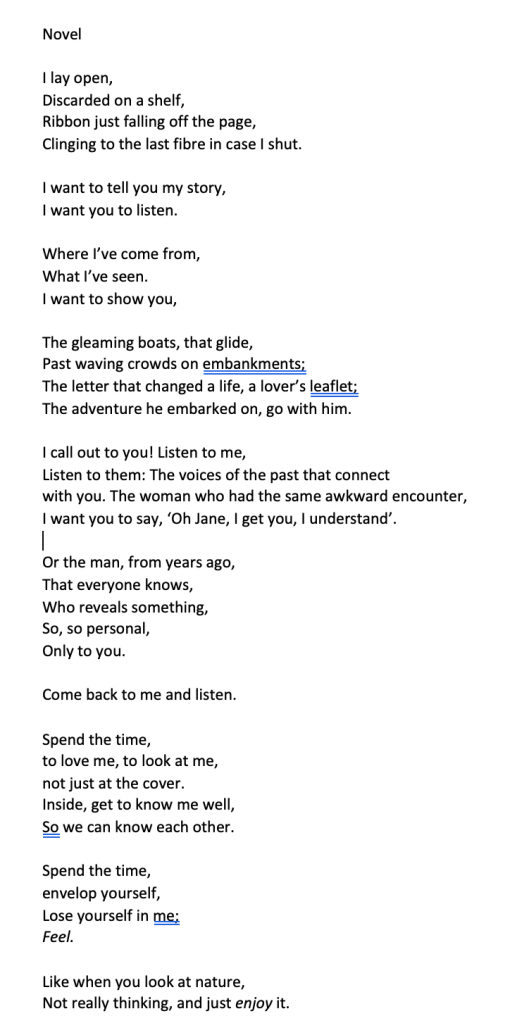
In this seminar we focussed on voice – so our task was to write a poem from the perspective of a person or an object that appears in our poetry, I chose the novel that gets abandoned in Locked/Looking from the Outside, and was pleased with the effect. To improve the poem I think I need to work on the rhythm of lines such as ‘past waving crowds on embankments’.
Supernatural Love – Gjertrud Schnackenberg
My father at the dictionary-stand
Touches the page to fully understand
The lamplit answer, tilting in his hand
His slowly scanning magnifying lens,
A blurry, glistening circle he suspends
Above the word “Carnation.” Then he bends
So near his eyes are magnified and blurred,
One finger on the miniature word,
As if he touched a single key and heard
A distant, plucked, infinitesimal string,
“The obligation due to every thing
That’s smaller than the universe.” I bring
My sewing needle close enough that I
Can watch my father through the needle’s eye,
As through a lens ground for a butterfly
Supernatural Love – Gjertrud Schnackenberg – 17/11/20
I flicked through my poetry anthology to find inspiration on rhythm and rhyming as these are the areas I feel I need to improve in my poetry. Schnackenberg’s Supernatural Love stood out to me because her use of enjambment allows her to use end-rhyme in a way that isn’t childish or clunky. She also presents a clear rhythm in her poem that focusses the reader on specific words effectively, like ‘lamplit’, ’tilting’, ‘hand’, and especially ‘Carnation’, which is further exaggerated by the quotation marks. I also love how Schnackenberg uses such small imagery. She starts broad and then focusses in on tiny details, for example the dictionary-stand, then the page, then the word ‘Carnation’, or the sewing needle and then the needle’s eye.
I also feel that Schnackenberg’s poem has a very distinct voice, almost of an inquisitive child, slowing down time to look deeply at the details of the world, just out of interest and beauty and wanting to savour the moment.
Link to full poem: https://www.poetryfoundation.org/poems/47547/supernatural-love
Wasps – 2nd draft (1st draft is in Forest Compilation) – 18/11/20
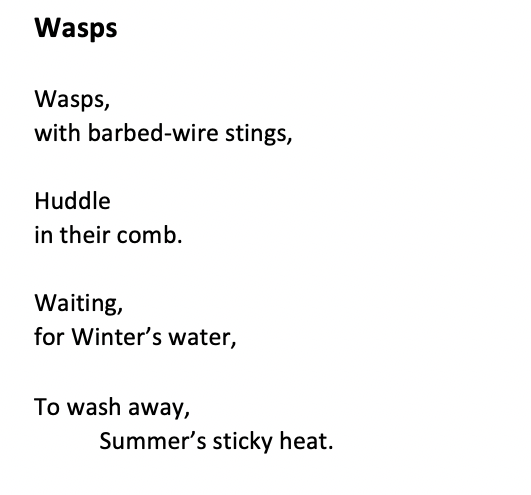
I think this poem has improved from the haiku version. I like the rhythm and structure, and how this is broken in the last stanza to enact the lingering heat being washed away. I like the idea of having a shorter poem in my compilation to add variety.
24/11/20 – On second reading, I think that the haiku version is more effective, as the aim of this poem is to suggest that the wasps are hiding away because of winter, whereas this suggests that they are waiting for winter to get rid of summer. I am unsure whether or not to keep Wasps as an individual poem, or to incorporate it into another poem.
Branches – 2nd Draft – 18/11/20
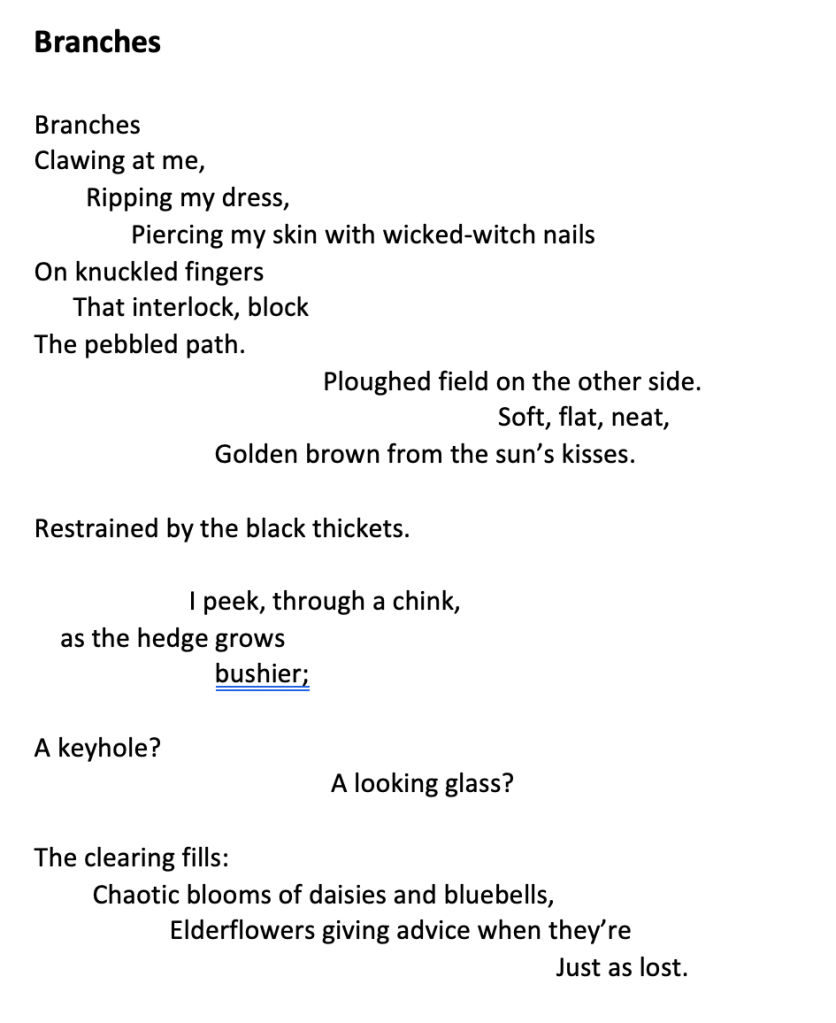
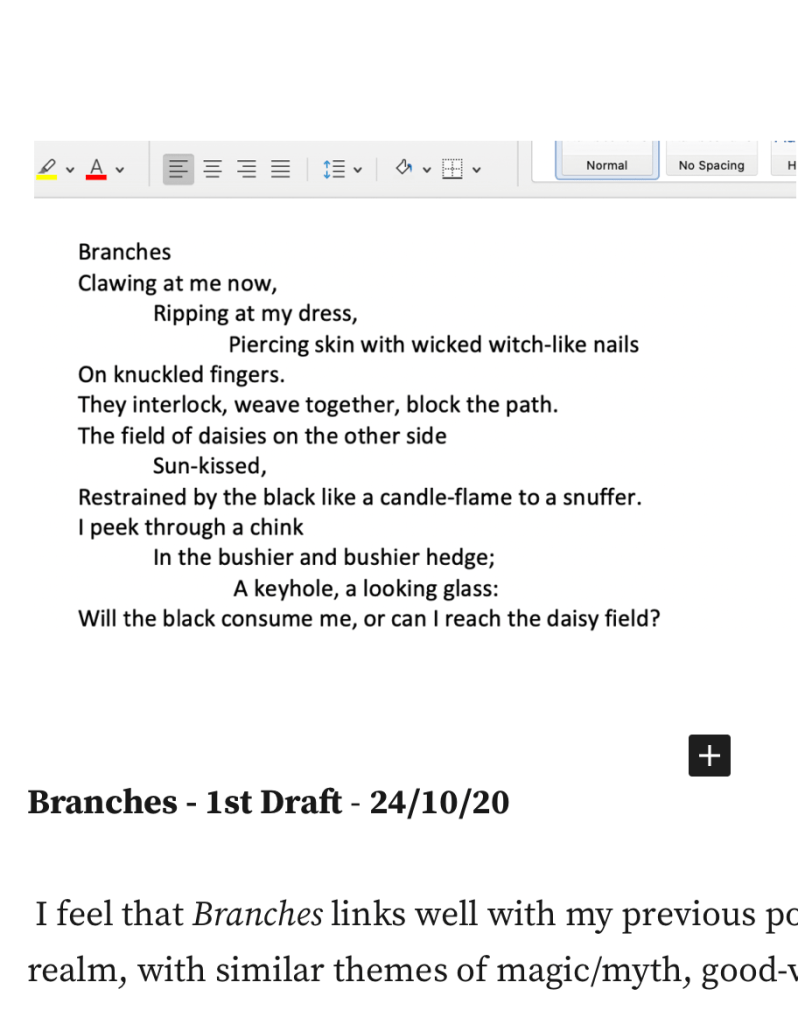
When editing this poem, I focussed on the shape of the poem trying to enact intertwining branches or a thick hedge that you are trying to get through. I also tried to make the poem less cliched and have more of a story-line and end point. I added a screenshot of the original draft to see the changes more clearly.
Rose – 3rd Draft – 19/11/20
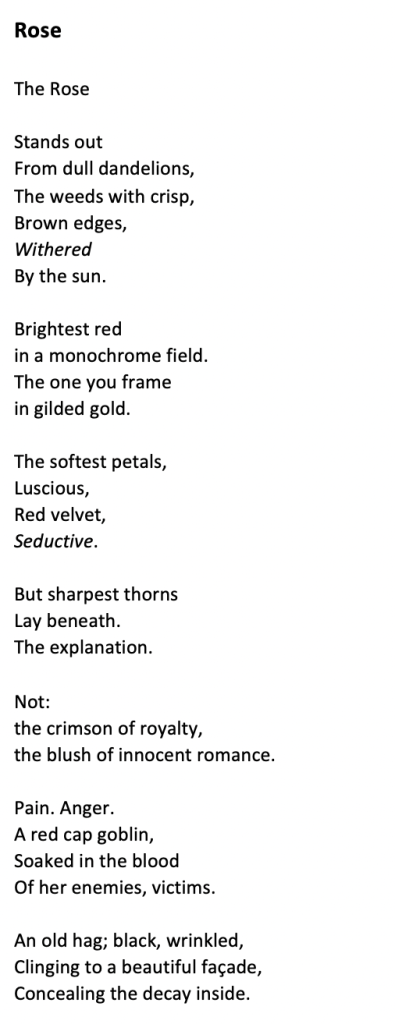
Here is a link to my post collecting all the drafts of Rose and explaining the development of the poem and the editing process:
Rose – Draft by Draft
Winter – 1st Draft – 21/11/20
Winter sits
at the mouth of the cave.
The mountain shivers,
The valley grumbles,
Wasps with barbed-wire stings huddle in their comb.
I watch, from the
Candle-scented,
Stove-flickered,
Room,
As a burnt leaf flakes to the ground.
The impact of a thick, fluid clump,
Knocking on the forest door.
Leaves crack, split, sizzle
Quick cold as the sun’s wick burns out.
My soft, white coat is waiting
On the hook.
I run, to the
Must-filled,
Rain-dampened,
Wood,
Where there is no one
and nothing, but wet leaves on my shoes.
And I am there to see if the tree falls,
No one else will dare to look;
Winter has scared them away.
- Although this poem has elements of previous poem drafts, it is the first draft of this actual poem. I took inspiration from Kristine O’Connell George’s poem Forest Walk, and am thinking about making this a sequence poem along with Locked/Looking from the Outside and Novel, as they all have quite similar tones and themes.
Muriel Rukeyser’s Ballad of Orange and Grape – 23/11/20
After you finish your work
after you do your day
after you’ve read your reading
after you’ve written your say –
you go down the street to the hot dog stand,
one block down and across the way.
On a blistering afternoon in East Harlem in the twentieth
century.
This poem by Rukeyser is one of my favourites, as it combines a light-hearted ballad style with serious, political content, to give a dramatic and memorable effect. The way that Rukeyser uses the ballad form is also very effective in that not only does it have a very flowing rhythm, it is also very noticeable and dramatic when she breaks it. This style could be helpful with regard to my poem Family Tree as I have tried the same idea of using a particular meter and breaking it for effect, however, I need to be more specific and impactful in the moments where it is broken.
Novel – 2nd Draft -25/11/20
I lay open,
Discarded on a shelf,
Ribbon just falling off the page,
I want to tell you my story,
I want you to listen.
I want to show you
Gleaming boats that glide,
Past waving crowds on river banks,
Sending metal-clad heroes to twenty-year wars.
I want you to embark.
Listen!
To the silent forest they trek through,
The leaves that whisper under bare feet,
The creaking metal wheel of a Tesco trolley
The terrified screech of ‘Here we are’.
I want you to smile because she knows how you feel,
And not understand how she can.
When they made me wet with their tears,
And told me what they couldn’t tell anyone else.
Come back to me and listen.
Look at me,
and not just the cover.
Inside, get to know me well,
And I can know you too.
I want you to love me,
But you want to tell your own story.
Novel 2nd Draft
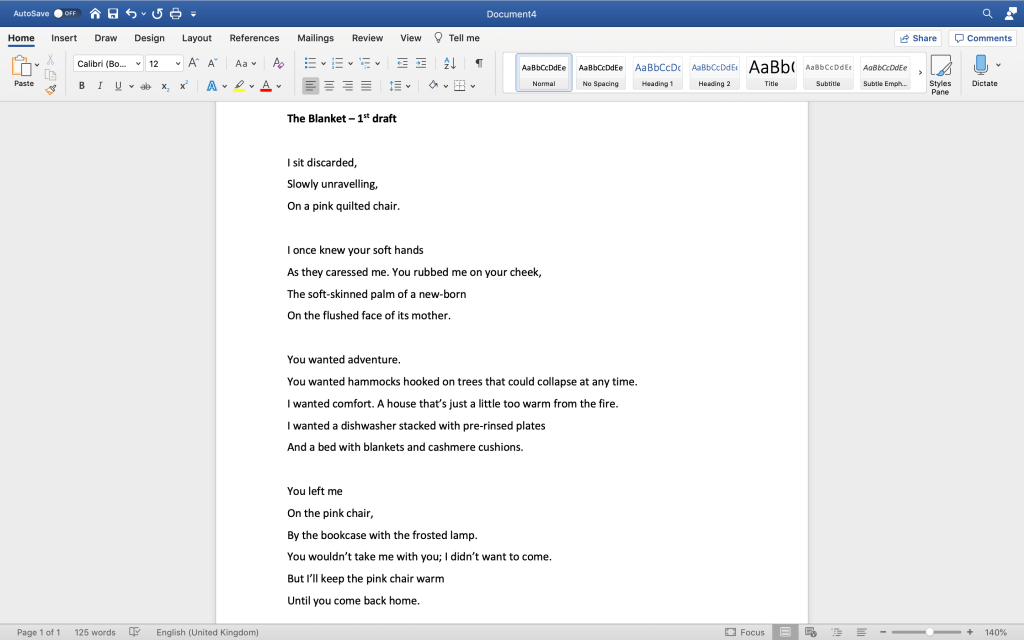
When editing this poem I had in mind the fact that I want to make it a sequence alongside Longing for Outside, so I focussed more on giving a tone arguing against the voice of that poem. The aim of the sequence is that the poems show differing views on what this person should do. In Longing for Outside, the narrator wants to go on an adventure and start their life, but struggle against the comforts of their home drawing them back. This poem then, through the perspective of the novel, wants the person to stay inside, and instead of making their own adventures, wants them to read about the adventures of others. I would like to add a third poem to the sequence from the perspective of the crocheted blanket, with a stringer sense of begging the person to stay inside.
I alluded to some of my favourite texts, The Odyssey, and The Road, with a focus on texts that centre around adventure and also the hardships of adventure, to create a sense of ‘these people have gone on adventures so you don’t have to’. I also like the begging voice of the novel, pleading with the person to stay and read her, which was partially inspired by how I always really want to read more books but life gets in the way.
The Blanket – 1st Draft – 29/11/20
Winter’s Turning – Amy Lowell (1874-1925) – from the book A Nature Poem for Every Night of the Year.
The title of this poem stuck out to me as I have explored the reverse of this theme of winter turning in some of my poetry, of summer turning to autumn/winter, rather than winter becoming spring. I love the celebratory tone of the poem ‘Let us throw up our hats’, and ‘race along the sidewalks’. I also think the end particularly stands out with the imagery of the calendar – ‘Winter drops into the waste-basket, / and the calendar calls it March’. I like how this personification really conjures the image of tearing off a page of a calendar and throwing it in the bin. Another aspect of the poem that stuck out to me was the repetition in ‘With the bloom of bricks, / Houses and houses of rose-red bricks’. I think the rhythm and the way the repetition builds is really effective in presenting an admired image, alongside the repeated connection to the flowers with ‘bloom’ and ‘rose-red’.
Forest compilation 2nd Draft – 10/12/20
Here is a link to the 2nd draft of my Forest compilation:
Recurring Themes
For my compilation I have looked through the different themes that connect the poems together.
The most frequently occurring were:
Nature, Forest, Fairytale, Seasons and Mental Health.
On account of this, I think I will base my compilation on the theme ‘Into the woods’ as nearly all of the poems fit into the forest theme, and many also have an element of longing to go into the woods specifically.
Longing for Outside Sequence – 10/12/20
I took inspiration from Taylor Swift in this sequence, in the way that, in her latest album Folklore, Swift creates a storyline across three songs, all telling a different perspective of one affair. The three songs could stand alone as separate stories, but put together, they subtly tell different accounts of the same story, using different voices and views. I have attempted to do the same thing as Swift in my sequence, as I have the main narrator, the person who wants to go outside but feels drawn in by the temptations of home comforts and has to really fight to leave. Secondly I tell the story from the perspective of the novel abandoned by the person, that calls out to them, asking them to stay and read the adventures of others instead of going on their own adventure. Finally I use the voice of the blanket crocheted by the person, again asking them to stay, but more for fear of the outside world and desire for a comfortable, cosy life. The blanket is mostly an allegory for a mother wanting her child to be safe and struggling with the idea of them leaving home.
Here is the link to the final draft of the Longing for Outside Sequence:
Here are the links for a draft by draft description of the development of each poem in my final compilation:
Here is a link to my final compilation of ten poems:
 Half Agony, Half Hope